

Agentic AI: The Next Evolution of Intelligent Nonprofit Systems
Gratona
Agentic AI is transforming how nonprofits operate by automating complex workflows, making independent decisions, and managing tasks with minimal human input. Unlike traditional AI, which requires constant oversight, agentic AI acts as a proactive virtual team member, enabling nonprofits to focus on their mission while improving efficiency and donor engagement.
Key Takeaways:
- What It Does: Automates tasks like donor communication, fundraising, and impact reporting while learning and adapting in real-time.
- Why It Matters: Helps nonprofits manage limited resources effectively, saving time and boosting donor retention.
- Real Results: Organizations using agentic AI have seen increased efficiency, better donor engagement, and cost savings.
- Challenges: Requires high-quality data, staff training, and ethical oversight to ensure effective implementation.
Agentic AI is not just about automation - it’s about enabling nonprofits to achieve more by letting technology handle repetitive tasks, so teams can focus on building meaningful relationships and driving their mission forward.
3 Nonprofit Fundraising Headaches (and How AI + Automation Can Solve Them)
What is Agentic AI and How It Differs from Traditional AI
Agentic AI is a cutting-edge, autonomous technology designed to handle complex workflows and manage entire processes without needing constant human oversight. Think of it as a proactive digital teammate that doesn’t just wait for instructions - it takes initiative. While traditional AI might tackle a single task when prompted, agentic AI looks at the bigger picture, evaluates goals, and independently executes the necessary steps to achieve them.
The main distinction lies in autonomy and how it operates. Traditional AI functions more like an advanced calculator: you input data, it follows predefined rules, and delivers results. Agentic AI, on the other hand, behaves more like a virtual coworker. Andy Snyder, Senior Vice President of Platform at Blackbaud, puts it this way:
"Once trained, agentic AI can feel more like a virtual coworker that can take initiative and drive outcomes, rather than simple automation".
One standout feature of agentic AI is its ability to continuously learn and adapt in real-time. For example, if it detects low engagement, it immediately adjusts its messaging strategy. This dynamic learning process allows agentic AI to refine its performance with every interaction, unlike traditional AI, which often requires manual updates or retraining to improve.
This difference becomes especially meaningful for nonprofits, particularly those managing child sponsorship programs. Traditional AI might help by segmenting donor lists, but agentic AI takes it further. It can manage multi-step engagement processes - identifying lapsed donors, crafting personalized re-engagement strategies, and executing them seamlessly. Geof Corb from Huron Consulting Group explains:
"In advancement, agentic AI can move beyond automation in nonprofit success to manage entire fundraising and engagement processes, translating strategic objectives into measurable outcomes through autonomous planning, coordinated action, and continuous learning".
For nonprofits, the transition from traditional AI to agentic AI is transformative. Instead of spending hours manually acting on AI-generated insights, staff can rely on agentic AI to handle those tasks autonomously. This frees up time for what truly matters: focusing on strategy, nurturing relationships, and fostering the human connections that drive their mission forward.
How Agentic AI Works in Child Sponsorship Programs
Child sponsorship programs often involve complex tasks like managing donor information and tracking outcomes. Agentic AI simplifies these processes by automating time-consuming workflows, allowing nonprofit teams to focus on fostering meaningful relationships with both sponsors and beneficiaries. This technology seamlessly integrates funding, personalized communication, and precise impact evaluations, making it a game-changer for these programs.
Automating Fundraising Tasks
Fundraising can be a daunting task for nonprofits, but agentic AI is changing the game. By automating grant management, it identifies relevant funding opportunities from thousands of sources, tracks deadlines, and manages reporting requirements. For example, federal grants have an average success rate of 25%, while state and local grants see a 52% success rate, highlighting the need for efficient management.
Agentic AI also plays a crucial role in donor retention. It scans databases to pinpoint sponsors who might stop giving and initiates engagement efforts to keep them involved. A notable example comes from Parkinson’s UK, which used AI to refine its direct mail campaign in 2021. By targeting a smaller, more specific audience, the organization secured about 2,800 gifts - outperforming the traditional approach by nearly 300 gifts and uncovering 411 donations that would have been missed otherwise. Ben Miller, Senior Vice President of Data Science and Analytics at Bonterra, emphasizes:
"With AI handling the busywork, teams can focus on what matters most - building meaningful relationships and staying connected to the human side of their mission".
This automation not only saves time but also enables nonprofits to engage donors in a more thoughtful and effective way.
Personalizing Donor Communication
Mass emails and generic messages no longer resonate with today’s donors. Agentic AI tackles this by analyzing donor behavior, giving patterns, and preferences to craft personalized communications at scale. It adjusts messaging, timing, and channels - whether email, SMS, or social media - based on how donors interact with previous outreach. For instance, from 2019 to 2025, Animal Haven, a nonprofit based in New York, collaborated with Fundraise Up to customize donation suggestions for website visitors. The result? A 264% increase in recurring donors.
Additionally, the technology provides 24/7 support, instantly addressing questions about tax receipts, sponsorship impact, or program details. With first-time donor retention rates typically hovering between 20% and 30%, and 75% of potential donors seeking clear evidence of impact before contributing, this kind of personalized engagement makes a huge difference. By keeping sponsors informed and appreciated, nonprofits can strengthen donor loyalty and ensure long-term support.
Improving Impact Reporting
Impact reporting is another area where agentic AI shines. It consolidates data from CRMs, event tools, and financial systems to create detailed, personalized impact reports. A standout example is Blue Star Families, which launched an AI agent prototype called "STAR" in September 2025. Built on the Salesforce Agentforce platform, STAR streamlined data entry and record management for 1.5 million military families. The result? A reduction of 400 administrative hours per week - saving about $20,000 weekly - while doubling data accuracy and speeding up processes.
Beyond efficiency, agentic AI scans diverse data sources, including program reports and donor feedback, to provide real-time insights. This transparency is vital for showcasing the impact of child sponsorship programs. Michael Kang, Vice President of Technology and Analytics at Blue Star Families, captures the vision perfectly:
"Our goal is to empower every user, regardless of technical background, to access insights and make data-driven decisions easily. In short, we're aiming to leverage agentic technology to become true administrative assistants for all our users".
Using Agentic AI with HelpYouSponsor
Manual vs Agentic AI Workflows in Nonprofit Sponsorship Management
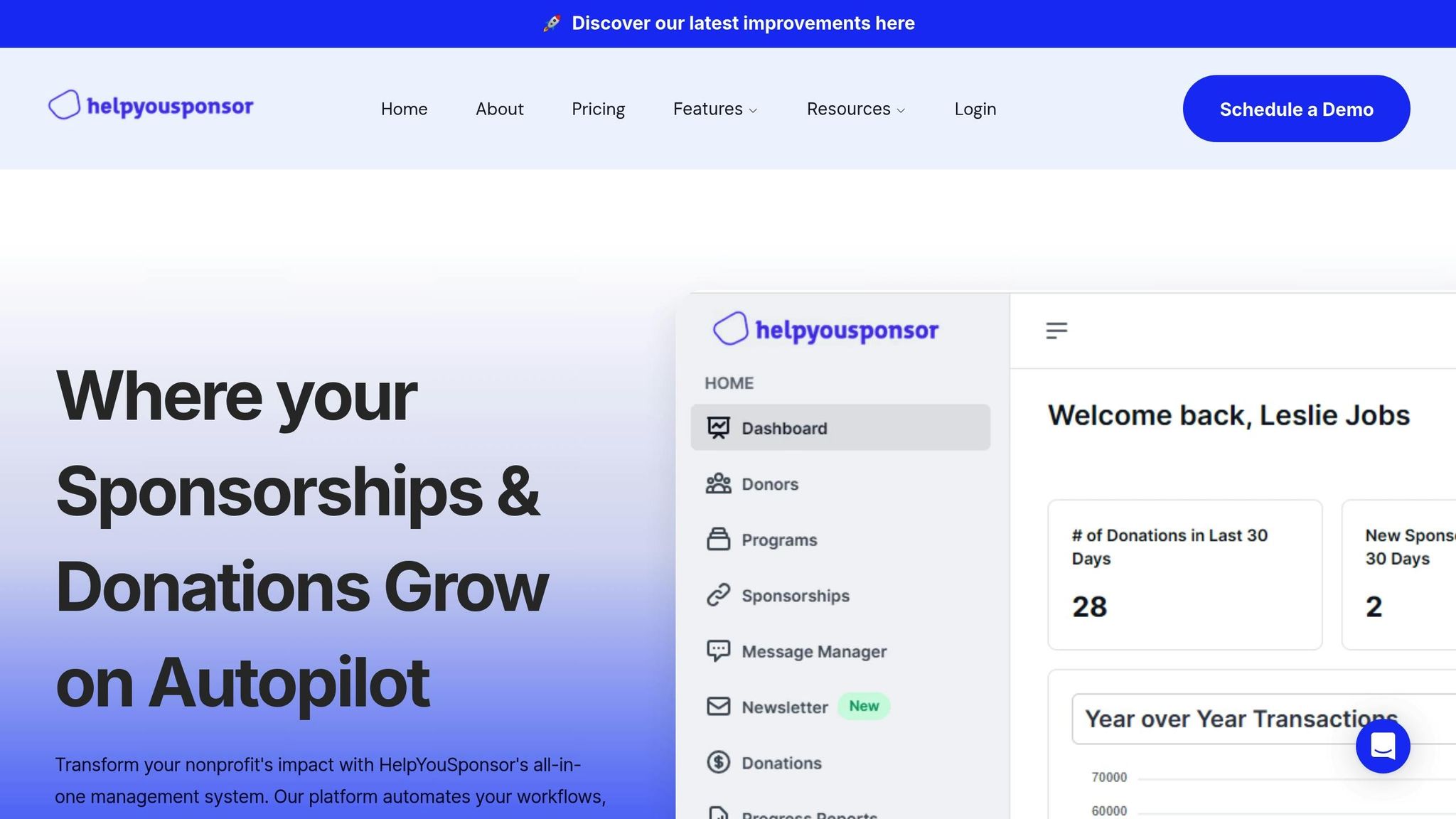
HelpYouSponsor brings agentic AI into the sponsorship process, simplifying workflows and eliminating the hassle of juggling multiple systems. To date, the platform has facilitated over $19 million in donations, helped organizations grow their sponsorships by 3.8×, and automated 90% of tasks. This automation allows nonprofits to focus on what truly matters: building and nurturing relationships. With integrations like Stripe, PayPal, QuickBooks, and Mailchimp, donor data flows effortlessly, cutting out manual entry entirely. Considering that 79% of nonprofits already use automation tools to manage donor data, HelpYouSponsor places your organization at the forefront of this growing trend. These seamless integrations not only save time but also enhance donor engagement and operational efficiency.
As discussed earlier, agentic AI’s ability to handle tasks autonomously takes sponsorship management to the next level with HelpYouSponsor.
Automation and Time Savings
Agentic AI is a game-changer for nonprofits by automating repetitive tasks. For example, the self-service donor portal allows sponsors to update their details, check donation histories, and download tax receipts on their own, drastically reducing the administrative burden. Automation tools can save nonprofits 20–30% of the time spent on manual work and cut costs by 15–20%. Automated messaging - such as welcome emails for new sponsors, quarterly updates, and renewal reminders - can boost repeat donations by over 80%. And since improving donor retention by just 10% can increase donor lifetime value by 50%, these tools directly support financial sustainability.
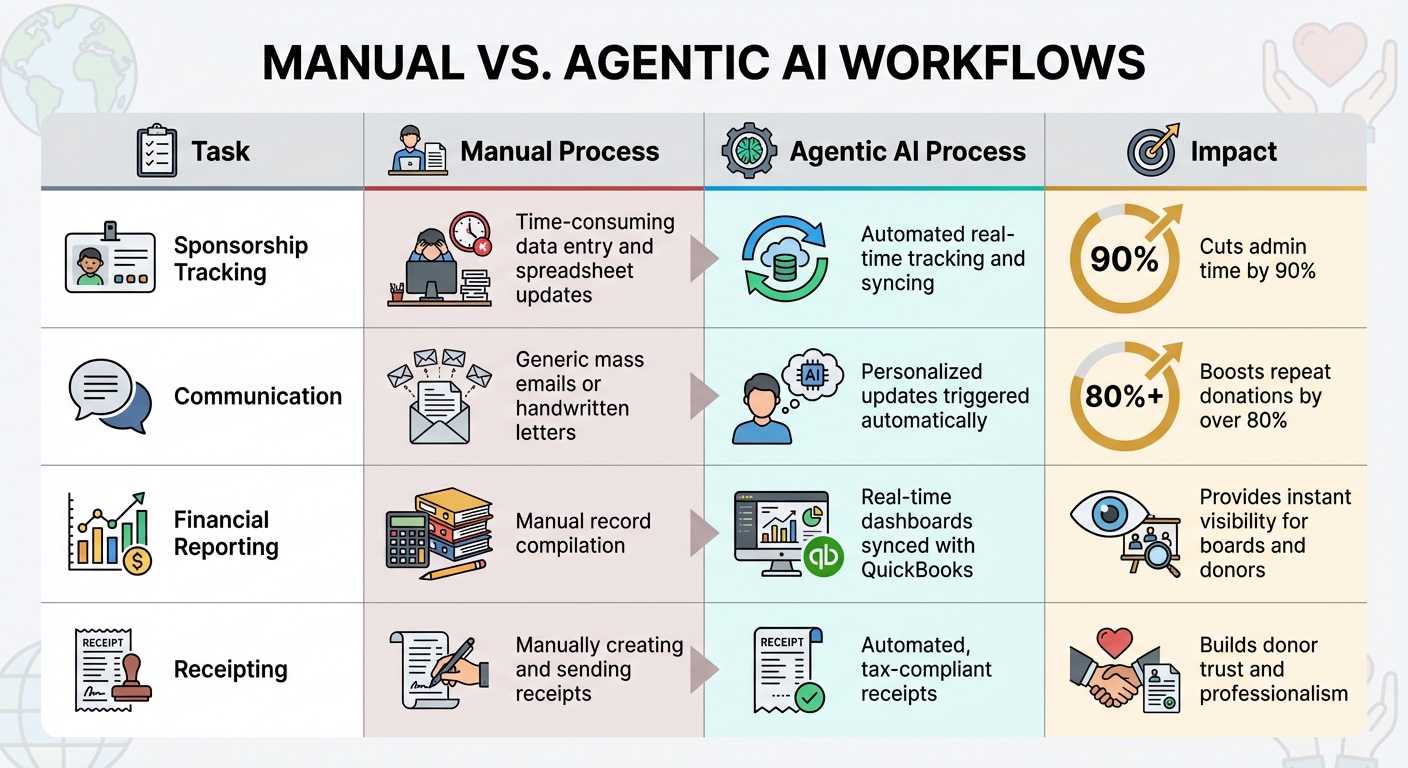
The contrast between manual workflows and AI-driven automation couldn’t be clearer, as the table below demonstrates.
Manual vs. Agentic AI Workflows
Here’s how agentic AI transforms key tasks compared to traditional manual processes:
| Task | Manual | Agentic AI | Sponsorship Impact |
|---|---|---|---|
| Sponsorship Tracking | Time-consuming data entry and spreadsheet updates | Automated real-time tracking and syncing | Cuts admin time by 90% |
| Communication | Generic mass emails or handwritten letters | Personalized updates triggered automatically | Boosts repeat donations by over 80% |
| Financial Reporting | Manual record compilation | Real-time dashboards synced with QuickBooks | Provides instant visibility for boards and donors |
| Receipting | Manually creating and sending receipts | Automated, tax-compliant receipts | Builds donor trust and professionalism |
To fully capitalize on these efficiencies, it’s essential to standardize data entry with a style guide to ensure clean, consistent inputs for AI tools. Use no-code platforms like Zapier or Make to connect HelpYouSponsor with other systems, and assign team members to oversee specific parts of your database to maintain data accuracy. Plus, since HelpYouSponsor is cloud-based, your team can access these tools from anywhere, making remote collaboration seamless.
How to Implement Agentic AI in Your Nonprofit
Introducing Agentic AI into your nonprofit doesn’t have to be a massive undertaking. Start with deliberate, strategic steps that align with your organization’s mission and goals.
Start with Small Pilot Projects
Kick things off with a focused pilot project that tackles a specific sponsorship challenge. For instance, you could use AI to clean up your sponsorship records by eliminating duplicate entries, standardizing formats, or identifying incomplete donor profiles. This controlled approach allows you to test AI capabilities without overwhelming your team.
Set clear objectives for your pilot. Are you aiming to automate repetitive tasks, improve donor engagement, or achieve better outcomes? For example, Save the Children launched an AI "support bot" during their end-of-year fundraising campaign and saw a 25% conversion rate. Assemble a team with diverse perspectives, including members from various departments - not just IT. This ensures the AI solution addresses the needs of everyone involved and helps identify potential issues early on.
To track progress, establish key performance indicators (KPIs) such as donor retention rates, response times, and engagement levels. During the pilot, monitor metrics like these closely. Personalized communication, for example, can increase contributions by 85%, while AI-driven follow-ups within 24 hours can boost donations by 30%. Use this data to refine your approach as needed. Once your pilot delivers promising results, shift your focus to strengthening your data systems.
Build a Strong Data Foundation
The effectiveness of Agentic AI hinges on the quality of your data. Before diving into AI tools, make sure your donor and sponsorship data is accurate, well-organized, and consistent. This might involve cleaning up existing records, setting standardized data entry procedures, and creating a style guide for your team.
Your data infrastructure should also support seamless integration with other tools. For example, HelpYouSponsor’s integrations with payment gateways can sync donor data automatically, reducing the chances of manual errors. However, maintaining data quality isn’t a one-time task - it requires ongoing effort. Assign team members to regularly audit and update your records.
Once your data foundation is solid, ensure that human oversight remains a key part of the process.
Maintain Human Oversight
While Agentic AI can improve efficiency, human judgment is irreplaceable. AI should enhance your team’s abilities, not take over critical decision-making or compassion-driven tasks. Human oversight is essential to ensure that AI outputs align with your nonprofit’s values and ethical standards. Develop a clear ethical framework to guide AI use, ensuring decisions are transparent, explainable, and free from bias.
Different AI tools serve different purposes, so it’s important to understand their roles. For sensitive donor interactions, have your staff review AI-generated communications before they’re sent. This extra layer of human involvement ensures your messaging remains empathetic and authentic - qualities that foster trust and build long-term donor relationships. While AI can streamline processes, it can’t replace the human touch that’s at the heart of nonprofit work.
Benefits and Challenges of Agentic AI in Child Sponsorship
Agentic AI is reshaping child sponsorship by offering scalable and automated engagement solutions. However, this technology also brings challenges that require careful consideration and management.
Benefits: Scalability and Personalization
One of the standout benefits of Agentic AI is its ability to operate around the clock. AI-powered chatbots can handle routine tasks like answering FAQs, processing donations, and sending sponsorship updates without interruption. This automation significantly reduces the administrative burden on human staff.
Another advantage is its capability to personalize donor engagement on a large scale. For instance, AI systems can craft email subject lines tailored to whether a donor contributes one-time or monthly. They can also suggest customized donation amounts by analyzing past giving patterns and financial indicators. Moreover, AI-driven follow-ups within 24 hours have been shown to increase donation rates by as much as 30%.
Agentic AI also supports donor retention by acting as an early warning system. By analyzing patterns, it can flag sponsors who might be at risk of discontinuing their support. This proactive approach strengthens relationships and ensures consistent engagement. In essence, Agentic AI functions like a virtual team member, managing donor oversight and coordinating multi-channel campaigns.
While these benefits enhance efficiency and personalization, there are challenges that organizations must address to fully leverage the potential of Agentic AI.
Challenges: Data Quality and Change Management
Maintaining high-quality data is a critical challenge. Since Agentic AI relies on accurate and well-structured information, issues like incomplete profiles, duplicate records, or inconsistent formatting can hinder its performance.
Another major hurdle is organizational change management. Simply adding AI to outdated workflows won’t yield meaningful results. Processes need to be redesigned to foster effective collaboration between humans and AI. Additionally, staff may feel uneasy about AI replacing their roles or struggle to adapt to new systems. As Geof Corb from Huron Consulting Group explains:
"AI can move beyond simple task automation to manage entire fundraising and engagement processes, translating strategic objectives into measurable outcomes through autonomous planning".
This shift requires organizations to invest in training, such as workshops on prompt engineering and AI-assisted relationship management.
Ethical and governance issues also come into play. Without clear policies, there’s a risk of privacy breaches, bias, and donor fatigue. To address these concerns, nonprofits should establish frameworks for transparency, compliance, and escalation processes. Additionally, there’s the potential to lose the “human touch” if AI-driven communications aren’t closely monitored. Engaging legal, IT, and donor relations teams early on is essential for crafting policies that safeguard data privacy and ensure transparency.
Benefits vs. Challenges Comparison
| Category | Benefits | Challenges |
|---|---|---|
| Efficiency | Automates up to 90% of administrative tasks | Requires reengineering workflows for effective human-AI collaboration |
| Donor Relations | Increases gift likelihood by 85% through personalization | Risk of losing the "human touch" without proper oversight |
| Scalability | 24/7 automation for handling routine tasks | Relies on high-quality, well-organized data |
| Retention | Identifies at-risk donors through early warning systems | Demands ongoing staff training and change management |
| Decision-Making | Adapts in real-time for contextual decisions | Requires governance frameworks to address bias and privacy concerns |
Conclusion
Agentic AI is reshaping the way nonprofits handle child sponsorship and donor engagement. By automating repetitive tasks, it frees up staff to concentrate on building relationships and driving meaningful impact. With features like smart donor matching, highly personalized communication, and instant reporting, it offers a powerful toolset for organizations looking to enhance their operations.
While the benefits are clear, adopting Agentic AI requires a thoughtful and measured approach. Balancing efficiency with human oversight is critical. Geof Corb from Huron Consulting Group puts it well:
"Retaining these functions [advising and mentoring] within human stewardship helps maintain trust and ensures that AI adoption reflects deliberate choices aligned with institutional goals, not blanket substitution".
This underscores the importance of starting small - piloting low-risk projects, building smarter donor systems, and ensuring human involvement in key decisions and relationship management.
The results speak for themselves. Organizations like Charity: Water have slashed response times from hours to mere seconds, boosting engagement by 40%. Advanced analytics, powered by AI, have also led to an 85% increase in fundraising success. This isn’t just about upgrading technology; it’s about strategically positioning nonprofits to amplify their mission.
Beyond these gains, no-code AI agents are now simplifying tasks like donor support, grant writing, and impact reporting. By embracing Agentic AI, nonprofits can reach more beneficiaries, connect with donors more effectively, and make a greater difference in their communities.
FAQs
What makes Agentic AI different from traditional AI in nonprofit work?
Agentic AI steps beyond the boundaries of traditional AI by functioning as a self-directed system capable of setting its own goals, planning actions, and adjusting dynamically in real time. Unlike traditional AI, which typically relies on human input to produce outputs like donor segmentation or predictive analytics, Agentic AI can autonomously handle tasks such as sending tailored outreach messages, updating sponsorship records, and organizing donor recognition events.
For nonprofits, this translates to full automation of routine activities like donor management, sponsorship alignment, and running fundraising campaigns. This frees up staff to concentrate on strategic initiatives. With its goal-oriented approach and capacity for continuous learning, Agentic AI can fine-tune outreach efforts, optimize donor portfolios, and adapt to evolving donor preferences - all without the need for constant manual updates or retraining.
What challenges might nonprofits face when adopting Agentic AI?
Adopting Agentic AI in nonprofits comes with its fair share of challenges, both technical and organizational. For starters, these systems rely heavily on high-quality data. This means nonprofits might need to focus on tasks like cleaning up existing data, integrating it across systems, and upgrading their infrastructure to ensure everything works seamlessly with older platforms. On top of that, staff training becomes essential. Employees need to learn how to manage, monitor, and troubleshoot these advanced systems, which not only adds to the costs but can also introduce a steep learning curve.
Then there’s the matter of governance and ethics. With the high level of autonomy that Agentic AI brings, nonprofits must ensure that its decisions stay true to their mission and meet donor expectations. This requires robust oversight. Safeguards must be in place to address potential bias, protect sensitive data, and ensure transparency in operations. Implementing this technology often means rethinking workflows, redistributing resources, and finding the right balance between embracing innovation and maintaining donor trust while adhering to regulatory standards.
How can nonprofits use Agentic AI responsibly and ethically?
To use Agentic AI responsibly, nonprofits need a well-defined governance framework. This framework should outline the roles and responsibilities of all involved parties - developers, program managers, and board members - and prioritize bias reduction, safety checks, and clear reporting of the AI's activities.
Practical measures like human-in-the-loop controls are essential for managing critical tasks, such as matching donors or distributing grants. These controls ensure that humans can intervene when necessary. Additionally, maintaining detailed audit logs to monitor the AI’s decisions and data usage is crucial. Regular internal reviews, paired with independent external audits, can confirm adherence to ethical guidelines and privacy laws.
Building trust with donors and beneficiaries hinges on transparency. Providing straightforward summaries of how the AI functions and how its decisions are reviewed signals accountability and a commitment to ethical conduct. By taking these steps, nonprofits can harness Agentic AI to support their mission without compromising their values.