

Why AI-Native Platforms Change How Nonprofits Operate
Gratona
AI-native platforms are transforming nonprofit operations by automating repetitive tasks, improving donor management, and increasing fundraising outcomes. These tools act like digital teammates, analyzing data to provide actionable insights and streamline workflows. Here's what you need to know:
- Efficiency Gains: Nonprofits save 15–25 hours weekly, cutting costs by over $20,000 annually.
- Donor Retention: Early adopters report up to a 35% increase in donor retention.
- Fundraising Boost: AI helps raise revenue by 30% and improves donor engagement rates significantly.
- Adoption Growth: AI usage in the nonprofit sector surged from 15% in 2023 to over 40% by 2025.
AI tools help nonprofits focus on their mission by simplifying donor management, solving common sponsorship challenges, and automating routine tasks. For example, predictive analytics can identify donors likely to lapse, while automated communications personalize outreach at scale. Platforms like HelpYouSponsor centralize sponsorship tracking and integrate payment processing, offering flexible pricing to fit organizations of all sizes.
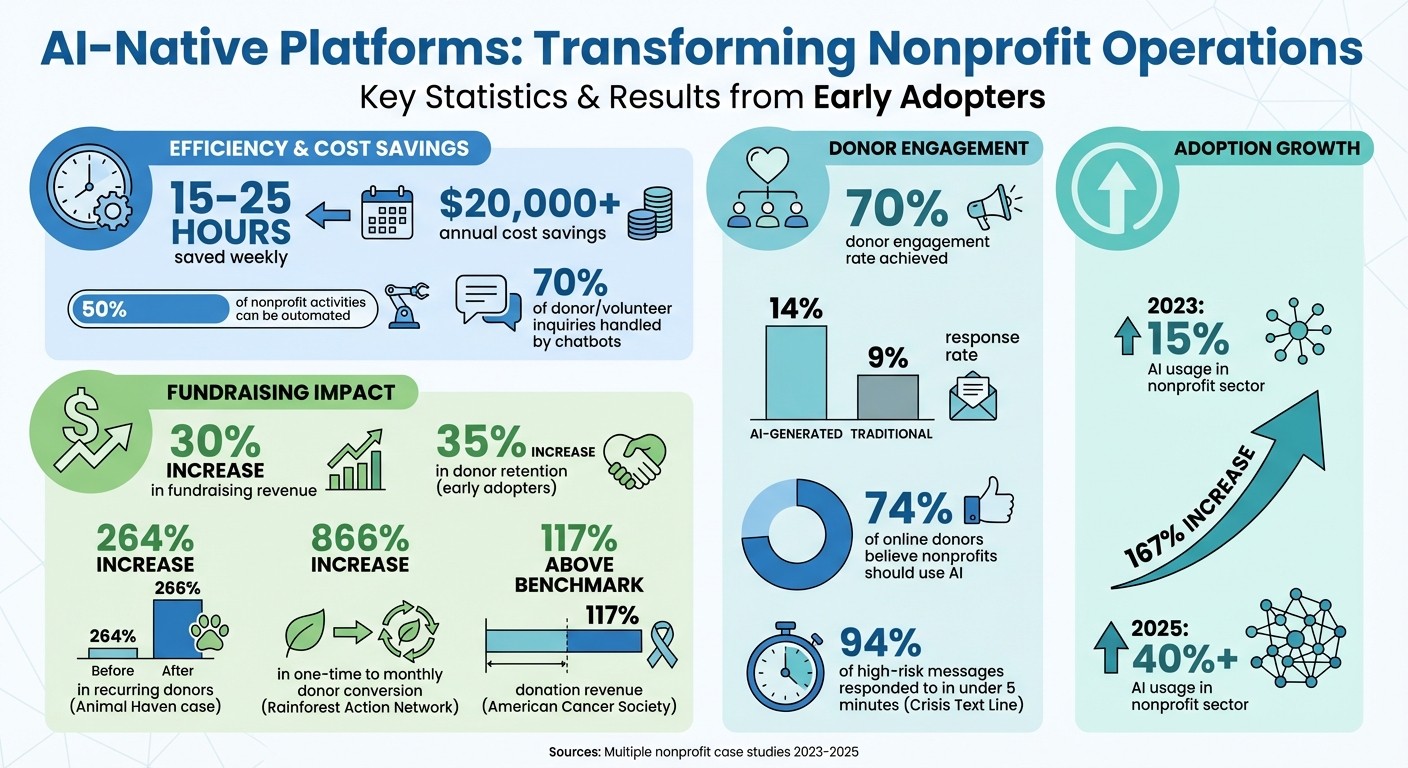
AI Impact on Nonprofit Operations: Key Statistics and Results
How AI Can Empower Nonprofit Organizations to Achieve Their Missions More Effectively - Albert Chen
How AI-Native Platforms Improve Nonprofit Operations
AI-native platforms address three major challenges nonprofits often face: managing donor relationships, raising funds effectively, and handling time-consuming administrative tasks. These platforms go beyond just digitizing workflows - they use data and machine learning to reshape how nonprofits operate.
Organizations leveraging AI have seen impressive results. For example, nonprofits report a 30% increase in fundraising revenue within a year and save 15–20 hours per week on administrative tasks. What's more, 74% of online donors believe nonprofits should utilize AI for marketing and fundraising efforts.
Simplifying Donor Management
AI platforms consolidate data from multiple sources - donation forms, website activity, and email engagement - to create a unified view of each supporter. This comprehensive perspective reveals giving trends, communication preferences, and engagement history, making donor management more effective.
Machine learning plays a critical role in donor retention by identifying those at risk of lapsing. This matters because donor acquisition can cost 50% more than the initial gift, and fewer than 25% of first-time donors continue giving. For instance, Animal Haven, a New York animal rescue, used AI to personalize donation suggestions on its website. The result? A 264% increase in recurring donors.
AI also automates essential donor communications, such as personalized thank-you notes, tax receipts, and impact reports. It can even segment donors into groups - like monthly supporters versus annual contributors - ensuring tailored outreach. For example, it can identify donors who prefer email over direct mail, allowing staff to focus on building deeper relationships while maintaining consistent communication with everyone.
These insights and automations create a strong foundation for smarter, data-driven fundraising efforts.
Increasing Fundraising Results
AI doesn’t just streamline donor management - it also makes fundraising strategies more precise. Predictive analytics analyze past giving patterns to forecast donor behavior, recommend donation amounts, and identify the best communication methods. Take the American Cancer Society, for example: by applying machine learning to optimize digital ad spending, they achieved donation revenue 117% above their benchmark and a donor engagement rate nearing 70%.
AI also excels at identifying potential major donors. By analyzing wealth indicators and engagement data, it highlights supporters ready for significant gift conversations. Parkinson's UK tested an AI-generated mailing list against a traditional one and saw striking results: the AI list had a 14% response rate compared to 9% for the traditional list, secured 2,800 gifts versus 2,500, and uncovered 411 additional gifts that would have otherwise been missed.
"Especially with generative AI, not only can it be a lever for becoming more efficient, but [nonprofits] can also free up time to do the things they do best, which is being donor‑centric, stewarding and cultivating those donors." – Ashutosh Nandeshwar, SVP of Data Science and Analytics, CCS Fundraising
AI also enhances campaigns in real time. Platforms can automatically A/B test email subject lines and donation page designs, adjusting elements to boost engagement. For example, Rainforest Action Network used AI to optimize the timing and content of fundraising appeals, leading to an 866% increase in converting one-time donors to monthly supporters.
By building efficient fundraising systems and automating routine tasks, nonprofits can dedicate more time and energy to their core mission.
Automating Routine Tasks
AI doesn’t just optimize donor engagement and fundraising - it also takes over repetitive tasks, helping nonprofits operate more efficiently. From data entry to generating receipts and tracking compliance, AI handles time-consuming operations seamlessly. Studies show that 50% of nonprofit activities can be automated, and chatbots can address up to 70% of common donor and volunteer inquiries.
The savings can be dramatic. Trek Medics used PagerDuty's automation tools over three years, saving $21,000 and 400 hours of manual work while reducing monthly incidents by 10%. Similarly, Intelehealth, a healthcare nonprofit, saved over $60,000 and resolved 3,810 incidents between 2023 and 2025 by implementing AI Ops for managing last-mile delivery.
Crisis response organizations also benefit significantly from AI automation. Step with Hope, under the leadership of Inna Kampen, used Automation Anywhere's bots to manage a 400% surge in humanitarian aid requests in Ukraine, automating the validation of requests from vulnerable families. Meanwhile, Crisis Text Line analyzed 65 million text messages with AI, enabling them to respond to 94% of high-risk messages in under five minutes.
| AI Tool Type | Primary Function | Key Benefit |
|---|---|---|
| Generative AI | Content creation (emails, social posts, grants) | Saves time on brainstorming and drafting |
| Predictive AI | Behavior forecasting (likelihood to give, gift size) | Identifies high-value prospects |
| NLP/Chatbots | Conversational support and sentiment analysis | Provides 24/7 donor support |
| RPA (Robotic Process Automation) | Data entry and form processing | Reduces errors and administrative overhead |
AI’s ability to automate tedious tasks and provide real-time insights allows nonprofits to focus on what they do best: making a difference in their communities.
Key Features of HelpYouSponsor
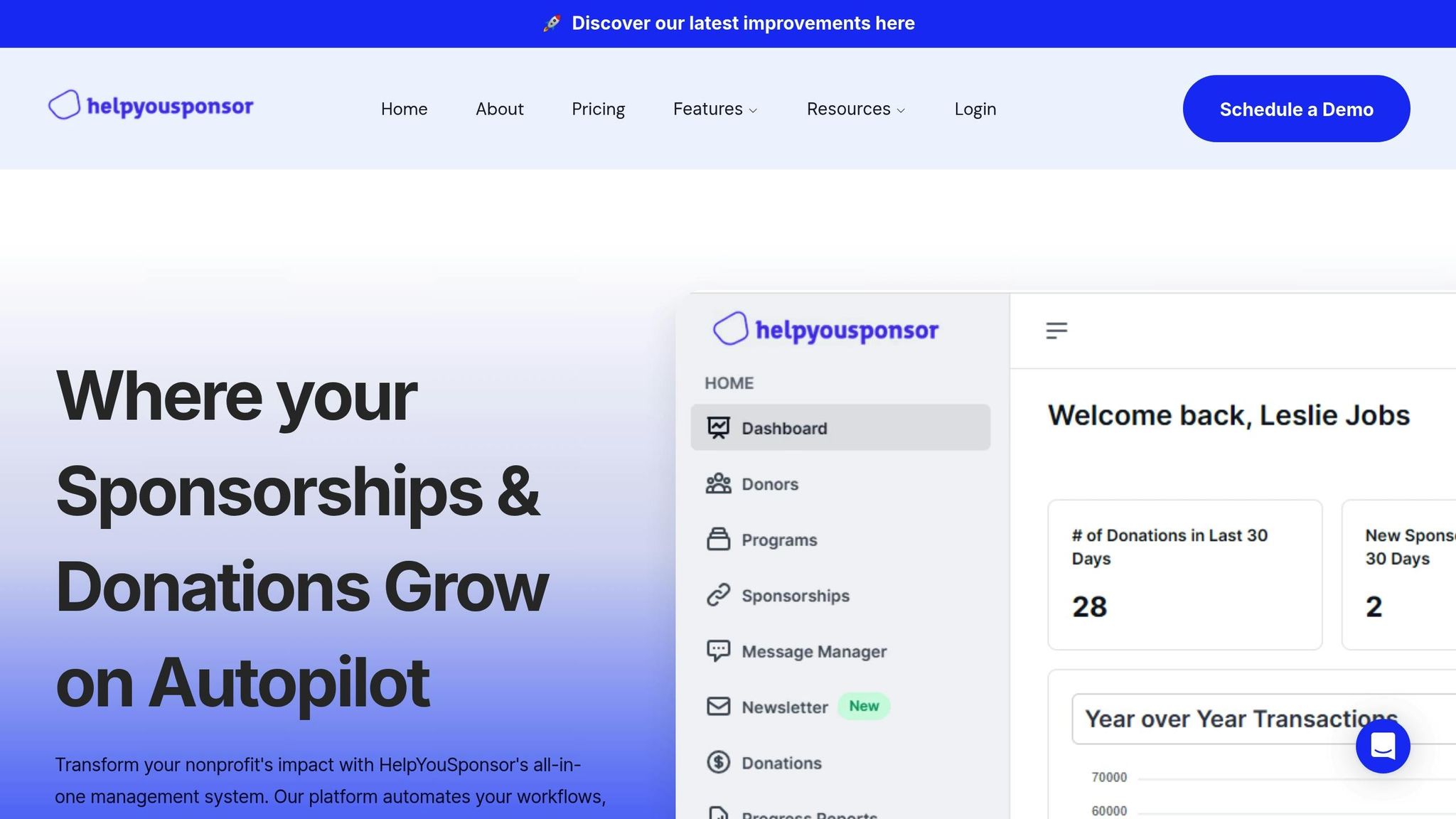
HelpYouSponsor is an AI-driven platform designed to simplify and enhance sponsorship management. Created by experts in the field, it focuses on three main features: multi-type sponsorship tracking, integrated payment and website tools, and flexible pricing plans that adapt as your organization grows.
Managing Multiple Sponsorship Types
With HelpYouSponsor, managing various sponsorship programs - whether for child welfare, medical needs, construction projects, or pastoral work - is streamlined into one centralized system. Its dashboard provides a clear overview, allowing you to monitor each sponsorship type with its unique reporting requirements while keeping an eye on overall donor activity. For instance, a nonprofit managing both education initiatives and medical aid campaigns can oversee both in one place. This makes it easy to see which donors are contributing to multiple projects and to identify patterns across different programs.
Payment Processing and Website Integration
HelpYouSponsor connects your website, payment systems, and donor management into a seamless workflow. When a supporter commits to a sponsorship on your site, the platform automatically sets up their donor account, processes their payment through built-in gateways, and updates your sponsorship displays in real time. This automation reduces the need for time-consuming manual data entry, freeing up your team to focus on donor engagement. Additionally, the platform includes a messaging system for direct communication with sponsors and automates receipts and thank-you messages, helping you maintain strong relationships with minimal effort.
Flexible Pricing Plans
HelpYouSponsor offers three pricing options to suit organizations of all sizes:
- Free Plan: Perfect for small nonprofits, this plan supports up to 10 commitments per month at no cost.
- Pro Plan: At $50/month, this plan accommodates up to 63 commitments, ideal for growing organizations.
- Max Plan: Designed for larger programs, this plan charges $0.80 per commitment, ensuring you only pay for what you use.
This pricing model grows with your organization, eliminating the steep costs and unnecessary complexity found in many traditional nonprofit tools. It’s a affordable donor management solution to scale without overpaying for features you don’t need.
How Nonprofits Use AI in Fundraising
Nonprofits are tapping into AI to better understand their donors, predict potential challenges, and expand their programs - all without needing to grow their teams. These tools provide smarter ways to analyze supporter behavior and create personalized fundraising strategies that drive results.
Using Predictive Analytics for Donor Behavior
AI-powered predictive analytics can spot patterns in donor behavior, helping nonprofits act before problems arise. By analyzing past donation habits, communication preferences, and engagement levels, these tools can flag supporters who might stop contributing. This allows organizations to reach out with personalized messages at just the right time.
Take Animal Haven, a New York-based animal rescue, as an example. In 2019, they partnered with an AI platform to tailor donation suggestions for website visitors in real time. By analyzing visitor behavior and recommending donation amounts, they saw a staggering 264% increase in recurring donors.
Similarly, Cure Alzheimer's Fund used AI-driven software to craft personalized emails based on each donor’s history. This targeted approach helped them raise an impressive $1.2 million in donations.
These insights don’t just help retain donors - they also create a solid foundation for scaling sponsorship efforts.
Growing Sponsorship Programs
In the past, growing a sponsorship program often meant hiring more staff to handle the workload. AI changes the game by automating repetitive tasks and offering data-driven insights that guide strategic growth.
For instance, Rainforest Action Network showcased this potential in May 2020. They used software to recommend specific content and pinpoint the best timing for fundraising appeals based on donor data. The result? An incredible 866% increase in converting one-time donors into monthly supporters. Achieving such results manually would have been a significant challenge.
"AI can help elevate philanthropic outcomes and, ultimately, better mission fulfillment."
– Ashutosh Nandeshwar, SVP of Data Science and Analytics, CCS Fundraising
How to Implement AI-Native Platforms
Adopting AI-native platforms doesn’t mean you need to completely overhaul your operations. The trick is to lay a strong foundation and then gradually expand as you start seeing results. Many nonprofits stumble by skipping the groundwork. To avoid this, focus on organizing your data and streamlining processes before diving into full-scale implementation.
Organizing Your Data First
Before connecting any AI platform, take a step back and audit your workflows to identify where time is being wasted. Common culprits include manual data entry, managing donor emails, and creating reports. Once you’ve pinpointed these problem areas, shift your attention to cleaning and standardizing your data.
Make sure to export and format key information - like donation histories, event attendance, and volunteer records - using consistent systems. For example, stick to formats like MM/DD/YYYY for dates and use unique identifiers such as email addresses. This step ensures that when you integrate AI tools, the insights they generate are accurate and reliable, rather than skewed by messy data.
Starting Small and Scaling Up
Rather than trying to automate everything at once, start with a small, focused pilot project. Choose a task with a clear impact, like automating thank-you emails or streamlining volunteer scheduling. This approach helps build confidence within your team and demonstrates the value of AI without overwhelming your resources. Using AI tools for nonprofits allows for a smoother transition from manual tasks to automated operations.
For example, HelpYouSponsor offers a pricing model that supports this gradual rollout. Their free plan allows up to 10 commitments per month, making it perfect for testing the waters with a small sponsorship program. As your needs grow, you can upgrade to the Pro plan at $50/month for up to 63 commitments or the Max plan at $0.80 per commitment, which lets you pay based on usage.
Starting with free or low-cost tools is a smart way to showcase AI’s potential without financial risk. Once your team sees the time saved and the value added, they’ll be more open to expanding AI use. With early success under your belt, you can begin tracking meaningful metrics to refine and scale your strategy.
Tracking Results with AI
Once your pilot is up and running and your data is in order, it’s time to measure results. Focus on metrics that directly tie to your mission, like donor retention rates, fundraising ROI, and the conversion of one-time donors into recurring supporters. AI-powered reporting tools can provide real-time insights into these areas, helping you see exactly how the technology is impacting your organization.
Nonprofits that have embraced AI early report impressive gains, such as donor retention rates increasing by up to 35%. To better understand the role AI plays in your success, consider running A/B tests to compare campaign outcomes with and without AI tools.
It’s essential to remember that AI is there to assist, not replace, human expertise. Always maintain oversight of AI-generated content to ensure it’s accurate and aligns with your organization’s tone and values. Involve teams across fundraising, operations, and programs in the process to make implementation more seamless and effective.
"AI can help elevate philanthropic outcomes and, ultimately, better mission fulfillment."
– Ashutosh Nandeshwar, SVP of Data Science and Analytics, CCS Fundraising
Conclusion
AI-powered platforms are transforming the way nonprofits operate by streamlining processes, tailoring donor interactions, and providing predictive insights. This evolution in fundraising allows organizations to meet rising donor expectations for smooth digital experiences - all without the need for additional staff.
Nonprofits leveraging AI have reported some striking results: over a 30% boost in fundraising revenue, a 52% reduction in support ticket resolution times, a 264% increase in recurring donors, nearly 70% donor engagement, and improved response rates climbing from 9% to 14%.
These outcomes highlight the potential of platforms like HelpYouSponsor to deliver customized, cost-efficient solutions. By turning these statistics into tangible benefits, HelpYouSponsor makes advanced AI tools accessible to nonprofits of all sizes. Whether you're managing child sponsorships, running campaigns, or focusing on general fundraising, the platform offers flexible pricing options. For instance, a free plan supports up to 10 commitments per month, while usage-based pricing at $0.80 per commitment ensures you only pay when the software actively supports your mission. Features like seamless payment gateway integration, automated donor communication, and centralized data management allow you to prioritize what truly matters: building stronger relationships and advancing your goals.
As Justin Spelhaug from Microsoft aptly states:
"AI can and will be a game-changer for nonprofits and fundraisers".
To adopt AI effectively, start with focused initiatives and maintain human oversight, enabling your team to dedicate more time to mission-critical efforts.
The future of nonprofit operations is already here, and AI is driving it forward. Use AI to enhance efficiency, deepen donor connections, and create measurable change.
FAQs
How do AI-native platforms help nonprofits improve donor retention?
AI-native platforms are transforming how nonprofits connect with their donors by using predictive analytics to anticipate when a donor might stop contributing. By examining past donation habits, levels of engagement, and even external influences like major life events, these tools can identify donors at risk of disengaging. From there, they suggest thoughtful, personalized actions - like sending a genuine thank-you note, sharing an impact story tailored to the donor’s interests, or timing a donation request just right.
These platforms also simplify donor stewardship by automating tasks such as crafting personalized messages, pinpointing the ideal donation amounts, and identifying the best times to reach out. Plus, they offer real-time insights into donor engagement, ensuring every interaction feels purposeful and meaningful. By reducing donor fatigue and fostering stronger loyalty, nonprofits using these tools often experience better retention rates and more reliable funding, allowing them to expand their reach and make a greater difference.
What steps should nonprofits take to start using AI effectively?
To effectively integrate AI, nonprofits should start by evaluating their readiness. Take a close look at your organization's data quality, technology infrastructure, and the skill levels of your team. This helps pinpoint areas that need improvement, setting the stage for a successful AI rollout.
Once you've assessed your foundation, choose a specific pilot project that ties directly to your mission. For example, you could use AI to improve donor engagement or streamline repetitive tasks. Starting with a manageable project allows you to test the technology, measure results, and fine-tune your strategy before expanding its use.
As you move forward, make ethics a priority. Focus on protecting data privacy and minimizing bias to build trust with stakeholders and ensure AI is used responsibly.
By following these steps, nonprofits can introduce AI tools with confidence, improving efficiency and advancing their goals in meaningful ways.
How can AI automation help nonprofits save time and work more efficiently?
AI automation is transforming the way nonprofits operate by handling repetitive, time-consuming tasks like donor data entry, grant writing, and compliance reporting. By taking these duties off staff members' plates, it reduces manual effort, cuts down on errors, and speeds up processes. This means teams can dedicate more time and energy to advancing their organization's mission.
Beyond individual tasks, AI can simplify entire workflows. It can automate approvals, schedule communications, and provide real-time insights. These tools don’t just save time and reduce expenses - they also help nonprofits work smarter. By freeing up resources, organizations can amplify their impact and better serve their communities.