
Best Practices for Corporate Sponsorship Proposals
Gratona
Corporate sponsorship proposals are not just about asking for money - they're about building partnerships that benefit both your nonprofit and the sponsor. In 2024, corporate giving in the U.S. reached $44.4 billion, highlighting the growing opportunities for nonprofits to secure funding through well-crafted proposals. Here's how to create proposals that stand out:
- Preparation Matters: Gather key documents like IRS Form 990 and an impact report to showcase transparency and credibility.
- Know Your Audience: Research potential sponsors' goals, such as their Corporate Social Responsibility (CSR) or Environmental, Social, and Governance (ESG) priorities.
- Be Specific: Clearly outline your program's goals, target population, and measurable outcomes.
- Offer Value: Show sponsors how their support aligns with their marketing goals, like brand visibility or employee engagement.
- Customize Your Proposal: Tailor each request to the sponsor's priorities and avoid generic pitches.
- Track Results: Commit to providing regular updates with metrics that demonstrate the impact of their support.
A strong proposal is clear, professional, and focused on mutual benefits. By following these steps, you can improve your chances of securing long-term partnerships with corporate sponsors.
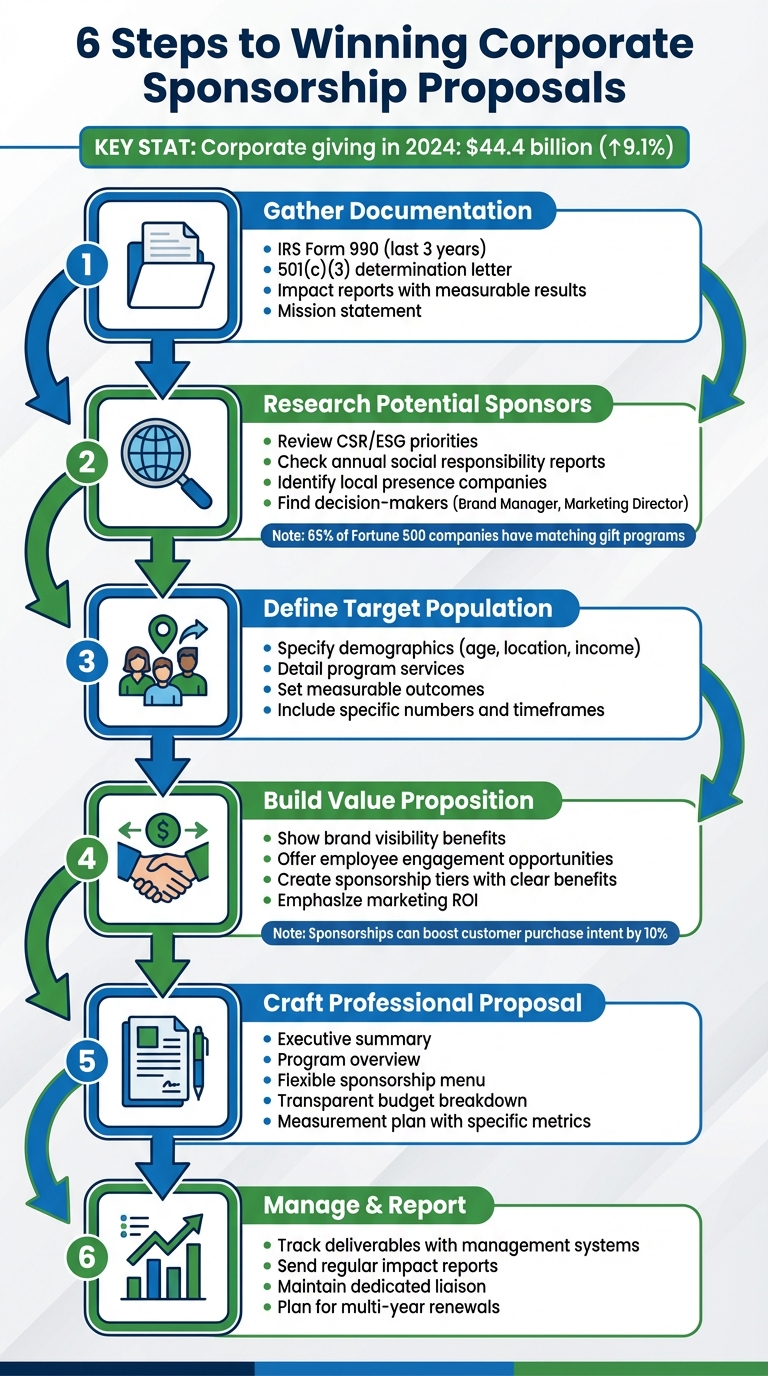
6-Step Process for Creating Winning Corporate Sponsorship Proposals
How to Create a Sponsorship Proposal That Will Actually Get Read!
Pre-Proposal Requirements
Before diving into your proposal, it's essential to gather the right documentation and conduct thorough research. This step ensures your organization demonstrates credibility, legal compliance, and alignment with a potential sponsor's goals. These are the building blocks of a proposal that stands out from the rest.
Organization Profile and Legal Status
Corporations often evaluate nonprofits by their 501(c)(3) tax-exempt status, which is a common requirement for corporate matching funds and foundation grants. Make sure you have your IRS determination letter and the last three years of Form 990 filings ready. These documents are legally required to be available for public inspection.
Your mission statement should be straightforward and clearly show how your values align with the sponsor's Corporate Social Responsibility (CSR) or Environmental, Social, and Governance (ESG) goals. Include measurable results from past programs - specific numbers like the number of children supported, educational milestones achieved, or communities impacted. This data reassures sponsors that your program is a low-risk investment. Additionally, highlight the expertise of your leadership team to establish credibility and trust.
| Document Type | Purpose for Sponsors | Availability Requirement |
|---|---|---|
| IRS Form 1023 | Verifies the organization is set up for exempt purposes | Must be publicly available |
| IRS Form 990 | Shows financial transparency and program spending | Last 3 years required |
| Determination Letter | Confirms official tax-exempt status | Critical for corporate compliance |
| Impact Report | Demonstrates program success with data | Strongly recommended |
Make it easy for sponsors to verify your nonprofit's legitimacy by providing direct links to your website or the IRS's searchable list of charitable organizations. If your child sponsorship program operates internationally, explain how you manage international child sponsorship programs to ensure funds are used appropriately for charitable purposes. This step reassures sponsors that their contributions remain tax-deductible.
With your nonprofit's credibility firmly established, shift focus to detailing who benefits from your programs.
Target Population and Program Details
Be specific about the demographics your program serves. Include details like age groups, geographic locations, income levels, and the challenges your beneficiaries face. Corporations often evaluate this information to determine whether your audience aligns with their own community or customer base.
When creating a child sponsorship program, describe it in clear, measurable terms. For example, specify how many children the funding will support, what services they will receive, and the outcomes you plan to track. Use precise numbers and timeframes - for instance, "providing meals, tutoring, and healthcare screenings for 500 children ages 6-12 in rural Tennessee over a 12-month period." Presenting this level of detail shows sponsors that their contributions will lead to tangible results.
"You want to show your humanity and make an emotional connection because a company is not going to sponsor you; it is a human being in that company that is going to decide to sponsor you." - Linda Hollander, SmallBizChat podcast
Position your program as an opportunity for collaboration rather than simply a request for funds. Framing your proposal as a strategic partnership helps demonstrate how both parties can benefit.
Once you've painted a clear picture of your program and its beneficiaries, tailor your proposal to match each sponsor's priorities.
Corporate Sponsor Research and Alignment
Generic proposals rarely succeed. Take the time to research each potential sponsor's CSR and ESG priorities before submitting your request. Review their annual social responsibility reports to identify their focus areas, such as education, sustainability, workforce development, or community health.
Your existing donor database can also provide valuable leads. Over 65% of Fortune 500 companies have matching gift programs, and you may already have connections through board members, major donors, or volunteers who work at these companies. A warm introduction can significantly improve your chances compared to cold outreach.
Focus on companies with a local presence in your service area. Businesses are often eager to build goodwill within their communities and prioritize partnerships that align with their local impact goals. Look for sponsors with a history of supporting causes similar to yours - if they’ve backed educational initiatives before, they’re more likely to support your child sponsorship program.
Identify the right decision-makers within the company. Titles like Brand Manager, Marketing Director, Sponsorship Manager, or Director of Community Affairs are often the key contacts. Many large corporations require proposals to be submitted through specific online portals, so avoid generic email addresses and follow their preferred process. If possible, schedule a discovery session before drafting your proposal. Use this opportunity to learn about their audience, goals, and what they value in a partnership.
Building Your Value Proposition
Corporate sponsorships are business deals, not acts of charity. Companies invest in partnerships that deliver measurable benefits like brand visibility, employee involvement, and alignment with their corporate social responsibility (CSR) goals. Your value proposition needs to clearly show what the sponsor gains while supporting your mission. This clarity lays the groundwork for outlining specific sponsorship requests and benefits.
Position your organization as a marketing opportunity rather than a funding plea. In 2024, corporate giving reached $44.4 billion, growing by 9.1%. A significant portion of this funding comes from marketing and advertising budgets instead of philanthropic foundations. Sponsors expect tangible returns on their investment, so your proposal must connect their contribution to measurable business outcomes.
Sponsorship Request Details
Be direct about what you’re asking for. Clearly state whether you’re seeking financial contributions, in-kind donations (such as products, services, or technology), or volunteer support from employees. Specify the exact amount and timeframe (e.g., "$15,000 over 12 months").
If a company provides goods or services with a market value, document that value and treat it as equivalent to a cash contribution. This approach allows companies to start small, building trust while exploring the partnership.
Break down funding requests into specific allocations, such as program materials, services, or administrative costs. This level of transparency reassures sponsors that their investment will lead to measurable outcomes.
Sponsorship Tiers and Benefits
Develop sponsorship levels that offer varying benefits based on the size of the investment. Avoid generic labels like "Gold" or "Silver." Instead, use descriptive names that align with the sponsor’s goals, such as "Community Champion" or "Education Innovator".
Design the tiers around what sponsors care about most: brand visibility, audience access, and social impact. Research shows that sponsorships can boost customer purchase intent by 10%, making brand exposure a strong motivator. Use standard market tools to assign fair pricing to these benefits.
| Sponsorship Level | Investment | Key Benefits | Business Value |
|---|---|---|---|
| Partner | $5,000 | Logo on website and two social media mentions | Brand visibility to 10,000+ followers |
| Advocate | $10,000 | Partner benefits plus quarterly impact reports and an employee volunteer day | CSR engagement and team involvement |
| Champion | $25,000 | Advocate benefits plus naming rights for a program element, speaking opportunities at events, and VIP networking access | Exclusive brand positioning and thought leadership |
Offer flexibility instead of sticking to rigid packages. Some sponsors might prioritize social media exposure over event participation, while others may value employee volunteer opportunities more. Create a customizable menu of options to let sponsors tailor their engagement based on their marketing goals.
Include opportunities for employee involvement, as this boosts morale within the company and strengthens their connection to your mission. Skilled volunteering - like financial planning workshops, technology training, or mentorship programs - can deliver meaningful value beyond monetary contributions.
Measurement and Reporting Plan
Once you’ve defined sponsorship options, back them up with measurable reporting. Sponsors want data that proves their investment made an impact. Commit to tracking specific outcomes, such as the number of beneficiaries served, improvements in education or health outcomes, or other key metrics tied to your mission.
"Sponsors want results they can measure. Including projected metrics in the sponsorship proposal format shows sponsors exactly what to expect." - Kayla Trettel, Vanco
Set a reporting schedule: quarterly updates for major sponsors and annual reports for others. Share key metrics and impactful stories. Use charts and infographics to make your results more engaging and easier to digest.
While sharing stories, respect the privacy of your beneficiaries. Use first names only, avoid identifiable photos without consent, and focus on overall outcomes rather than individual cases. Sponsors will appreciate your ethical approach to storytelling.
Track marketing metrics that matter to sponsors, such as logo impressions, social media reach, website traffic, media mentions, and leads captured through email sign-ups or contests. Calculate the advertising value of logo exposure to show how their sponsorship delivered both marketing ROI and social impact. This data strengthens the case for continued or expanded support.
Proposal Format and Content
Start with a cover page that includes your organization's name, logo, event details, and a brief introductory letter summarizing the key benefits of the proposal. Follow this with a one-paragraph executive summary that clearly states your mission and the purpose of the proposal. Highlight audience demographics to ensure the proposal aligns with potential sponsors' goals. Provide an overview of the program or event, including its name, date, location, and objectives.
Offer sponsorship options as a flexible menu, detailing the associated benefits - like logo placement or speaking opportunities. Include a straightforward budget breakdown to show how funds will be allocated. Additionally, outline an impact and measurement plan that explains how success will be tracked and reported. These elements should come together to create a cohesive and persuasive proposal, following the fundamentals of effective nonprofit sponsorship programs.
Required Proposal Sections
Begin with a cover page and introductory letter. Next, include an executive summary that succinctly communicates your nonprofit's mission and the proposal's purpose in just a few sentences. The program or event overview should provide the essentials: its name, date, location, and goals. Present a detailed sponsorship menu with options and associated benefits. Add a transparent budget breakdown that explains exactly how funds will be used. Include a measurement plan with specific metrics to track and report results. Wrap up with a strong call to action, including a commitment form, a response deadline, and direct contact information for your sponsorship coordinator.
Writing Style and Visual Presentation
Once the content is in place, focus on style and visuals to maintain clarity and professionalism. Keep paragraphs short - no more than five lines or three sentences per paragraph. Use professional, business-oriented language, emphasizing terms like "ROI", "brand impressions", and "audience demographics" to appeal to sponsors' marketing goals.
"Clarity is king. Ensure your proposal includes measurable goals and outcomes." - Double the Donation
Avoid generic greetings like "To Whom It May Concern". Research specific contacts and personalize your introduction. Steer clear of language that highlights organizational struggles; instead, project confidence by emphasizing how sponsorships help sponsors meet their objectives.
To reinforce your brand identity, use consistent colors, fonts, and logos throughout the document. Design the proposal with ample white space and a simple two-to-three color scheme to create a clean, professional appearance that builds trust.
Supporting Data and Stories
Simplify complex information with visual elements like infographics and charts. These tools help busy decision-makers quickly understand key data, such as audience demographics or budget breakdowns. Include mockups showing where a sponsor's logo could appear - on t-shirts, banners, or event signage.
Combine data with compelling stories to create an emotional connection. Photos of beneficiaries or volunteers can provide tangible evidence of your organization's impact. Use impact statements to help sponsors envision the results of their investment. However, always respect privacy - use first names and avoid identifiable photos without proper consent. This thoughtful approach not only demonstrates professionalism but also builds a meaningful connection with your mission. Together, these visuals and narratives enhance the structured framework of your proposal.
Systems and Relationship Management
Landing a sponsorship deal is just the first step. To deliver on your promises, you need reliable management systems in place. After closing a deal, set up tools to track commitments, streamline payments, and create detailed impact reports. Platforms like HelpYouSponsor simplify sponsorship management by centralizing donor relationships and ensuring deliverables stay on track. Analytics tools can also help you measure key metrics like logo impressions and return on investment (ROI). For instance, between 2023 and 2024, Gatorade leveraged targeted sponsorship tracking to secure 51 deals in women’s sports, showing how data-driven systems can scale partnerships effectively. These systems are the backbone of successful sponsorship management.
Sponsorship Management Systems
Choose software that helps you manage dates, contacts, and deliverables efficiently. HelpYouSponsor, for example, offers features like donor account management, integrated messaging, and website sponsorship displays. To stay organized, create a fulfillment checklist that tracks every promised benefit - whether it’s logo placements or speaking engagements - so you can ensure each commitment is met and improve your chances of securing renewals. Additionally, corporate databases can identify companies offering matching gift programs or volunteer grants, helping you expand your potential partner list. High-stakes partnerships, like the UFC and DraftKings’ $350 million, five-year deal, highlight the importance of tracking systems for managing complex deliverables and payment schedules.
Compliance and Ethical Standards
Every partnership should be formalized with a legally binding agreement that outlines payment schedules, liability terms, and cancellation policies. Include clear sponsorship policies, data privacy practices, and ethical branding guidelines in your proposal. Use first-party data provided voluntarily to offer demographic insights while maintaining privacy. When sharing reports, stick to aggregate data - such as total attendance by demographic - and avoid sharing individual registration lists or contact details without explicit consent. Transparency is key, especially as 68% of consumers favor eco-conscious brands, making it essential for sponsors to align with partners who share their ethical and environmental values.
Sponsor Communication and Renewal Strategy
Signing a sponsor is just the beginning - it’s estimated to account for only 20% of the effort. Assign a dedicated liaison to manage the relationship and schedule regular updates, recognition events, and performance reviews to maintain strong partnerships. After each event or program cycle, send detailed impact reports highlighting metrics like attendance, social media reach, and specific outcomes for beneficiaries. This is especially critical when reporting sponsorship outcomes for individual programs. Treat every sponsor as a long-term partner rather than a one-time deal. Explore multi-year renewals early in the relationship to ensure stability and mutual growth.
Conclusion
A winning proposal boils down to clear, concise communication, mutual benefits, and reliable systems. To capture a sponsor's interest, your proposal needs to answer the big question: "What's in it for me?" Sponsors are drawn to tangible benefits like increased brand visibility, lead generation, and a boost to their company's reputation. With corporate giving reaching all-time highs, businesses are actively searching for partnerships that make a difference. Showcasing how your organization delivers measurable results while maintaining transparency and ethical practices is the cornerstone of a strong proposal.
Generic approaches fall flat; personalized proposals are far more effective. Invest time in researching the decision-makers at potential sponsor companies and reference their recent community efforts. Avoid generic greetings - it’s the details that make an impression. If securing cash sponsorships proves difficult, consider suggesting in-kind donations as an alternative. Plus, sponsorships don’t just benefit organizations; they can boost customer purchase intent by 10%. Crafting a tailored proposal lays the groundwork for a meaningful, long-term relationship.
"Sponsorship is a transaction and when sponsors don't get what they paid for, they will ask for a refund or worse, they will tell their colleagues how terrible you are to work with." - Chris Baylis, Founder & CEO, The Sponsorship Collective
Once you’ve secured a sponsor, effective management is key to turning a one-time deal into a lasting partnership. Tools like HelpYouSponsor simplify this process by centralizing donor relationships, tracking deliverables, and automating communication. These features are especially important in an environment where only 52% of Americans trusted nonprofits in 2023. The platform’s pay-as-you-go model ensures you’re only charged when it’s actively supporting your program, making it a scalable solution for organizations of all sizes.
Treat every sponsor as a long-term partner. Regular impact reports, dedicated points of contact, and proactive renewal discussions can transform a single deal into an enduring collaboration. With a thoughtful approach and the right systems in place, your proposals will stand out in today’s competitive sponsorship landscape.
FAQs
How can I make my nonprofit's proposal align with a sponsor's CSR or ESG goals?
To make your nonprofit’s proposal align with a sponsor’s Corporate Social Responsibility (CSR) or Environmental, Social, and Governance (ESG) goals, start by digging into the company’s priorities. Check out their CSR or ESG reports, sustainability sections on their website, and press releases to pinpoint their focus areas - whether it’s environmental efforts, promoting diversity, or supporting community initiatives.
In your proposal, show a clear connection between your nonprofit’s mission and their objectives. Back it up with specific data, like the number of people your programs reach, the amount of CO₂ emissions reduced, or the funds directed toward local projects. Be sure to include a section that covers:
- The specific goal your nonprofit supports (e.g., climate action, equity, or health initiatives).
- Tangible impact metrics (e.g., $150,000 worth of services delivered, 10 tons of CO₂ offset).
- A reporting plan, such as quarterly updates and a final summary of results.
Highlight shared values and suggest ways to collaborate on visibility, like co-branded press releases, event banners, or employee volunteer opportunities. Using tools like HelpYouSponsor, you can track and share real-time metrics, ensuring transparency and building trust. By clearly showing how your nonprofit can help them achieve their CSR or ESG goals, you’ll boost your chances of securing support and creating a lasting partnership.
What should be included in a corporate sponsorship proposal to make it successful?
A great corporate sponsorship proposal needs a few key elements to stand out. Start with a concise executive summary that grabs attention right away. Follow that with an overview of your nonprofit’s mission and audience demographics to show how your goals align with the sponsor’s interests. Clearly outline sponsorship opportunities, detailing the benefits the sponsor will gain by partnering with you.
Don’t forget to include an activation or marketing plan that highlights how the sponsorship will be promoted. Add a budget with tiered sponsorship levels to give potential sponsors flexible options. Finally, include measurable ROI metrics to show the value they’ll receive from the partnership.
By crafting a polished and persuasive proposal, you can clearly demonstrate how this collaboration will create mutual benefits for both your organization and the sponsor.
How can I effectively measure and share the results of a corporate sponsorship?
To gauge the impact of a corporate sponsorship, start by pinpointing the sponsor’s main objectives - whether it’s boosting brand visibility, engaging with a specific audience, or generating leads. Once those goals are clear, choose measurable KPIs that directly align with them. Tools like real-time dashboards can help you track metrics such as impressions, ROI, or website traffic throughout the campaign, giving you the ability to monitor progress and identify trends as they unfold.
When it’s time to share results, focus on presenting a clear and compelling summary. Combine hard numbers - like $150,000 in media value or a 12% increase in website traffic - with meaningful qualitative insights, such as stories from beneficiaries or examples of employee involvement. Use an easy-to-digest format, like a PDF or online report, to clearly showcase the sponsorship’s value. Platforms such as HelpYouSponsor can make this process easier by automating data collection and creating polished, professional reports tailored to the sponsor’s priorities.