

Donor Engagement Mistakes to Avoid in a Child Sponsorship Ministry
Gratona
Child sponsorship programs rely on strong donor relationships, but common mistakes can weaken trust and reduce long-term support. Here’s what to watch out for:
- Poor Communication: Inconsistent updates and unclear fund allocation leave donors feeling disconnected.
- Lack of Transparency: Misleading expectations, such as whether funds benefit one child or a community, erode trust.
- Failure to Show Impact: Donors need measurable results and stories that highlight their contributions.
- Weak Relationships: Treating donors as mere sources of funding, rather than partners, discourages loyalty.
- Disorganized Data: Mismanaged donor information leads to errors, missed opportunities, and lost confidence.
These missteps hurt donor retention, with only 23% of first-time online donors returning. Clear communication, regular updates, and personalized engagement are key to building trust and ensuring ongoing support. By addressing these issues, ministries can strengthen donor connections and make a greater impact.
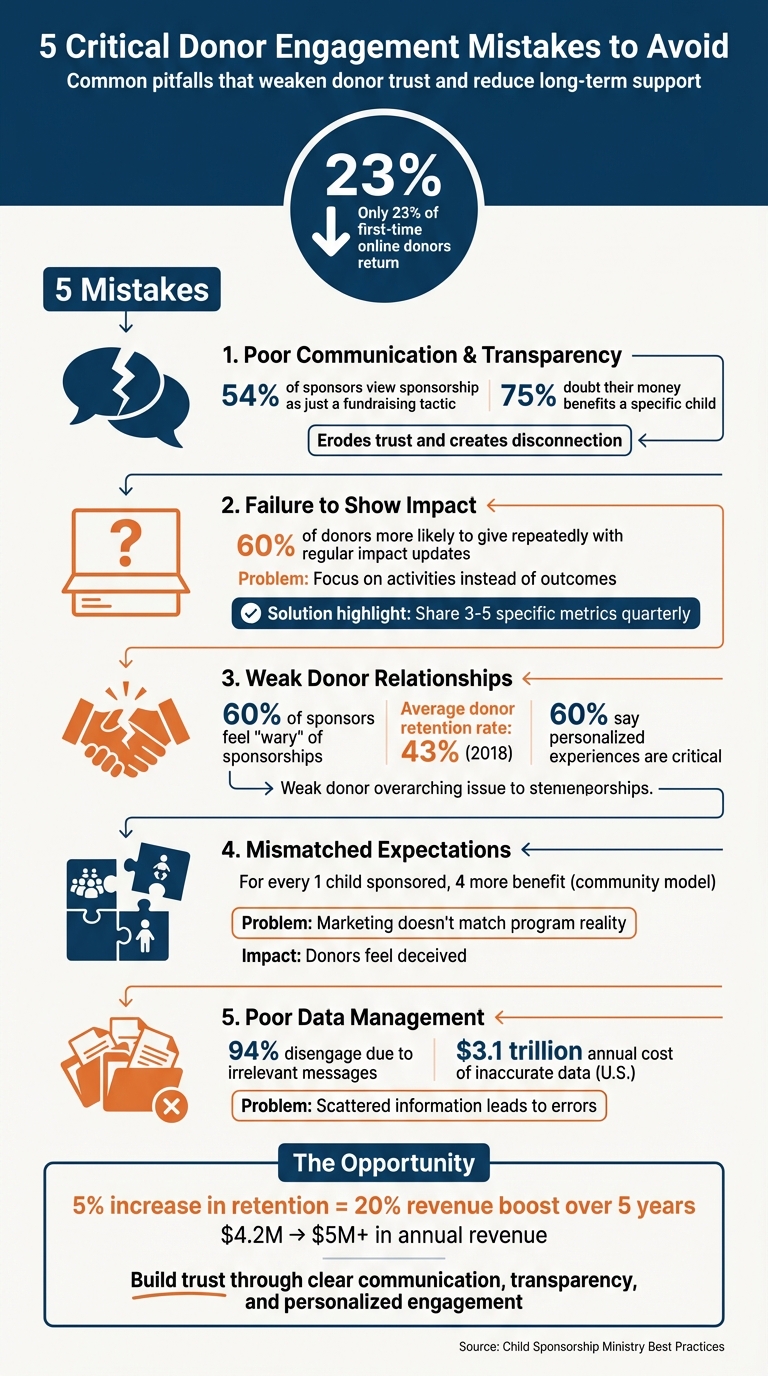
5 Critical Donor Engagement Mistakes and Their Impact on Child Sponsorship Ministries
Building Bridges of Trust
Poor Communication and Transparency
Strong communication does more than just explain how funds are used - it builds a meaningful, partner-like relationship with donors. When sponsors rarely hear from your ministry or don’t understand how their contributions are being used, trust begins to erode. Many donors end up feeling like they’re merely funding sources rather than active partners in the mission. This transactional approach creates distance, leaving donors to wonder if their contributions are making any real difference.
Here’s a striking example: increasing donor retention by just 5% over two years can boost revenue by 20% over five years. For an organization with $4.2 million in annual revenue, that’s a jump to over $5 million. Yet, many ministries miss out on this potential because their communication is inconsistent.
Unclear Fund Allocation
When donors aren’t sure how their money is being used, it can seriously hurt your credibility. For instance, some ministries fail to clarify whether donations directly support an individual child (through a 1:1 sponsorship model) or fund broader community programs. When donors discover the reality, they may feel misled. This confusion fuels skepticism - 54% of sponsors see child sponsorship as a mere fundraising tactic, and 75% doubt their money actually benefits a specific child.
To combat this, sponsorship materials should clearly outline how donations are allocated. For example, World Vision allocates 89% of funds to community-wide development programs, while Children International directs 82% to initiatives focused on individual child support. Being upfront about your model - whether it’s child-focused, community-based, or a mix of both - can help dispel the perception that sponsorship is just a "gimmick." Transparency here is key to earning donor trust.
Once donors understand how funds are allocated, it’s easier to build a foundation for regular, open communication.
Irregular Updates to Donors
Transparency doesn’t stop at fund allocation - it requires regular communication to keep donors engaged. Sporadic updates, especially if they only come during fundraising campaigns, can leave sponsors feeling undervalued and used. This lack of consistent outreach often leads to donor attrition and stagnant growth.
To address this, establish a reliable communication schedule. At a minimum, aim for quarterly updates, though monthly touchpoints are even better. Take inspiration from organizations like She's the First. Between 2015 and 2020, the nonprofit shifted to bi-annual newsletters featuring essays and artwork from the girls they support. This approach not only highlighted progress but also showcased the girls’ voices. As a result, individual donor revenue grew from 31% in 2015 to 37.4% in 2020. The takeaway? Regular, meaningful updates that highlight real progress can deepen donor loyalty and strengthen long-term commitment.
Failure to Show Donor Impact
When donors can't see the tangible outcomes of their contributions, they begin to question whether their support is making a difference. This uncertainty is significant: 54% of child sponsors consider sponsorships merely as fundraising tactics, and 75% doubt that their funds directly benefit the child they are supporting. Without clear evidence of impact, even the most dedicated sponsors may lose interest over time.
The issue often lies in how organizations report their efforts. Instead of focusing on outcomes, many emphasize activities. Nicola Scoon highlights this distinction:
"Donors care most about outcomes, not activities. Instead of focusing on actions like 'We held 42 workshops,' highlight results such as '87% of participants reported increased confidence.'"
Shifting the focus from what was done to what has changed is critical to keeping donors engaged and committed through effective donor stewardship.
Sharing Measurable Results
Specific metrics can transform vague claims into concrete proof of impact. For example, instead of saying, "We are helping children", share measurable results like improvements in literacy rates, math proficiency, vaccination coverage, or access to clean water. Regularly providing these metrics helps donors see the real changes their contributions make.
It's important to balance data with context. As Unmesh Sheth from Sopact explains:
"Numbers answer 'how much,' stories answer 'so what.' Donors need both to understand magnitude and meaning."
When sharing results, frame the narrative around the donor's role. For instance, instead of saying, "We served 100 children", say, "Your support enabled 100 children to access education". This subtle shift positions donors as active participants in the success story, rather than passive contributors.
To make this process efficient, consider implementing a simple system to track key metrics. For education programs, monitor literacy rates and graduation rates quarterly. For health initiatives, track vaccination coverage and growth benchmarks monthly. Share a handful of specific metrics - ideally 3–5 - that clearly demonstrate progress, not just effort. Be transparent about challenges as well, which can help build trust.
These measurable insights lay the groundwork for powerful storytelling that brings the impact to life.
Using Stories to Show Impact
While numbers provide evidence, stories create emotional connections that statistics alone cannot achieve. Real-life accounts of how sponsorship has changed a child's life help donors feel more connected to the beneficiaries - a phenomenon known as "transportation", which deepens engagement.
The most compelling stories often follow a "before and after" structure. Highlight where a child started, the obstacles they faced, and the specific improvements made possible by sponsorship. For example, a child might go from sporadic school attendance to graduating with honors, or a community might expand its shelter capacity from 10 beds to 30 thanks to donor contributions. These vivid transformations help donors visualize the difference they've made.
Sixty percent of donors are more likely to give repeatedly if they receive regular updates about the impact of their gift. Keep these updates personal and focused on progress and achievements rather than hardships. Include photos, drawings, or even short video messages from the child to make the story more engaging and heartfelt.
To maintain donor engagement, establish a timeline for regular story-based updates. For example, send an initial program update one month after a donation, followed by quarterly testimonials, photos, or videos. Work closely with program staff to continuously gather compelling stories that highlight the impact. When donors see how their contributions have directly transformed lives, they move from being mere supporters to passionate advocates for your cause.
Weak Donor Relationships
When sponsors are treated as nothing more than checkbooks, their enthusiasm for your mission fades fast. The stats back this up: 60% of child sponsors admit to feeling "wary" of sponsorships, and 54% view them as just another fundraising ploy. This kind of skepticism doesn’t appear out of thin air - it grows when organizations only reach out with their hand out, turning the relationship into a cold, transactional exchange. And that, in turn, leads to donor fatigue.
This transactional mindset can also encourage unhealthy donor habits, where supporters focus more on short-term "feel-good moments" than on the long-term well-being of the children they’re sponsoring. Without meaningful connections, even the most generous donors can drift away, contributing to the sobering reality that the average donor retention rate was just 43% in 2018. To keep donors engaged, organizations need to shift from treating these interactions as transactions to building genuine, lasting partnerships.
Building trust starts with making the relationship personal. Invite sponsors to get involved in ways beyond giving - such as volunteering, joining small groups, or attending behind-the-scenes events. Don’t assume your most loyal donors are already deeply engaged; extend clear, personal invitations to bring them closer to your mission.
Personalizing Donor Interactions
To bridge the gap and re-engage disconnected donors, personalization is non-negotiable. Generic emails that feel like mass mailings send the wrong message - that sponsors are just names in a database. And here’s the kicker: 60% of donors say personalized experiences are critical to keeping their support. Personalization goes far beyond adding a first name to an email - it’s about referencing their unique contributions and showing the direct impact of their generosity.
Start by segmenting donors based on their interests and giving history, then tailor your communications accordingly. Use automated systems to celebrate meaningful milestones, like sponsorship anniversaries, with personalized certificates or video updates from the child they’re helping. Follow up quickly - a thank-you email or letter should go out within 48 to 72 hours of receiving a donation. And when you communicate, use "you" language more often than "we" or "I" to emphasize the donor’s role as the hero in your story.
Recognizing and Thanking Donors
Strategic gratitude isn’t just good manners - it’s a retention strategy. Donors are 39% more likely to give again if they’re called within 48 hours of donating, and 41% more likely to stay engaged when they receive personalized thanks. On the flip side, 13% stop giving if they don’t feel properly appreciated .
How you say "thank you" matters just as much as saying it. For high-impact donors, handwritten notes can leave a lasting impression, while personal calls from board members or even your CEO can make major supporters feel valued. Sponsors of specific children might appreciate personalized videos or photos that show the difference they’re making. Mark sponsorship anniversaries with thoughtful gestures like certificates or small tokens of appreciation. You could even offer "VIP" experiences, such as virtual meet-and-greets with sponsored children or behind-the-scenes tours of your facilities. These thoughtful touches turn casual donors into lifelong partners in your mission.
Mismatched Expectations and Messaging
Donor trust takes a hit when the reality of sponsorship doesn't line up with what was promised. Many donors believe they’re the sole supporter of "their" sponsored child, expecting their $39 monthly donation to cover specific needs like school uniforms, books, or meals for that one child. However, most programs use a community-based model where funds are pooled to fund projects like wells, health centers, or schools that benefit entire villages. When donors eventually realize their contributions don’t work the way they imagined, they often feel deceived. For every one child sponsored in a community-led model, four more children in the same community typically benefit from the shared resources.
This disconnect does more than just hurt donations. When promotional materials focus on "devastating details" of a child’s life to provoke emotional giving, it can cause long-term harm to that child and perpetuate problematic "white savior" narratives, which can erode local dignity and institutions. Heather Nozea, Director of Child Protection at Rapha International, raises an important concern:
"Can you imagine how that will feel when that child gets a bit older and finds the most devastating details of their life posted publicly?"
These gaps between donor expectations and program realities highlight the need for clear, upfront communication about how sponsorship works.
Explaining the Sponsorship Model Clearly
Transparency should begin before a donor makes their first contribution. If your program focuses on community-wide benefits rather than individual support, make this clear from the start - right in your headlines or subheadings. For example, instead of saying "Sponsor a Child", consider using phrasing like "Child and Community Sponsorship" to set accurate expectations from the beginning.
The donation page on your website is a critical touchpoint for clarity. Spell out how funds are used before or alongside the "donate now" button, not buried in fine print or hidden on an "About" page. A clear FAQ section can explain whether the donor is supporting one child directly or contributing to a broader community effort. Be explicit about your model: is it "Direct" (a one-to-one child sponsorship), "Community" (pooled funds for shared projects), or "Hybrid" (a mix of individual and community benefits)? Donors deserve to know exactly how their money will be used.
It’s also crucial to have protocols in place for when children leave your program. Sponsors should be notified immediately if their sponsored child moves away or ages out. Offer donors the option to transfer their sponsorship to another child or cancel it altogether. Continuing to collect funds for a child who is no longer in the program isn’t just bad practice - it’s a serious breach of trust that can tarnish your reputation. Consistent transparency is key to maintaining donor confidence.
This same clarity about your sponsorship model should extend across all marketing materials to ensure trust and credibility.
Matching Marketing to Program Reality
Your promotional materials must align with what actually happens on the ground. Use consistent language across all platforms. For instance, if 80% of donations go to field programs and 20% covers administrative and fundraising costs (a typical breakdown for organizations like World Vision), state this openly and explain why those administrative expenses are essential for running effective programs.
Avoid using emotionally manipulative tactics. Instead, focus on the strength and resilience of the children and communities you serve. Highlight local staff and community leaders as the driving forces behind change rather than portraying donors as saviors. Margaret Schuler, Senior Vice President at World Vision, puts it this way:
"Sponsorship gives the sponsor the opportunity to form a personal relationship with a child, be their champion, watch him or her grow over time... and ensure that their well-being is tracked".
This approach frames the relationship as a partnership rather than a rescue mission.
Be specific about what each donation accomplishes. For example, saying "$10 buys a mosquito net" sets clear expectations and is far more effective than vague appeals like "help us fight poverty". Share measurable outcomes with defined timeframes. For instance, sponsored children are 27% to 40% more likely to finish high school and 14% to 17% more likely to secure salaried jobs as adults. These facts show real, tangible impact without overpromising or creating unrealistic expectations about immediate change.
Poor Donor Data Management
When donor information is scattered across spreadsheets, sticky notes, and email threads, errors are bound to happen. Imagine a sponsor receiving a thank-you letter meant for someone else, or duplicate appeals landing in their inbox within days of each other. Even worse, a recurring $50 monthly donation might be mistakenly recorded as $5 for months on end. These missteps not only waste resources but also erode the trust donors place in your organization. In fact, about 94% of people who disengage with an organization cite irrelevant messages or promotions as the reason. Keeping donor data organized is the cornerstone of meaningful donor engagement.
The financial toll of poor data management is staggering. In the U.S. alone, inaccurate data costs organizations approximately $3.1 trillion every year. For child sponsorship ministries operating on lean budgets, even a small portion of that waste can lead to tough decisions - expanding programs or scaling back critical services. Outdated addresses, duplicate profiles, or incorrect donation records not only waste potential opportunities but also weaken donor confidence. Accurate records don’t just save money - they strengthen trust and deepen donor relationships.
Consolidating Donor Information
Shifting from scattered systems to a child sponsorship software can transform your operations. When everyone on your team has access to the same up-to-date information, you avoid blunders like double-thanking a donor or sending a lapsed supporter an inappropriate appeal. A centralized system keeps everything in one place - contact information, giving history, communication preferences, and even notes from past interactions.
Automation is another game-changer. It ensures timely thank-you notes, accurate tax receipts, and regular updates, all while reducing human error. For instance, our Free plan supports up to 10 sponsorships, while the Pro plan, priced at $39/month, can manage up to 80.
However, maintaining clean data requires ongoing effort. Set a regular maintenance schedule to stay on top of things. For example:
- Update contact details monthly to reduce email bounce-backs.
- Remove duplicate profiles every two months to keep segmentation clear.
- Verify donation records quarterly to ensure financial accuracy.
- Enrich donor profiles with preferences and interests twice a year.
These small, consistent actions prevent minor issues from snowballing into major problems. Once your data is consolidated and well-maintained, creating targeted donor segments becomes much simpler and far more effective.
Segmenting Donors for Better Outreach
Grouping donors by shared traits allows for more personalized and impactful communication. With accurate data, you can sort sponsors based on giving habits, how they were acquired, and their level of engagement. For example, a donor contributing $25 monthly shouldn’t receive the same request as someone who gave a one-time $500 gift. Similarly, someone who joined through your website may respond differently than someone recruited at a community event.
Employer data offers another valuable segmentation opportunity. Corporate matching gift programs generate between $4 billion and $7 billion annually for nonprofits. By identifying donors whose employers offer matching gifts or volunteer grants, you can maximize these opportunities.
Engagement is another critical factor. Segment donors based on their involvement - like event attendance, volunteer hours, or social media activity. Highly engaged donors might be ready to take on bigger roles, such as joining an advisory board or leading a fundraising campaign. On the other hand, donors who have become less active may need a personal phone call to rekindle their connection before they drift away entirely. A clean, centralized database makes this kind of segmentation easy and ensures your outreach feels relevant and meaningful.
Conclusion
The challenges discussed - such as poor communication, unclear impact, weak relationships, mismatched expectations, and disorganized data - can seriously harm your ministry. Each one erodes donor trust. When sponsors feel disconnected or uncertain about how their contributions are being used, they’re much more likely to stop supporting. Considering donor acquisition strategies can cost up to five times more than retention, losing supporters isn’t just disheartening - it’s a financial strain.
Strengthening donor engagement isn’t just a good idea; it’s essential for the long-term health of your ministry. Clear communication about how funds are used, regular updates that show measurable progress, and personal interactions can build trust. These actions highlight the real impact recurring donations have - whether it’s helping a child graduate high school or providing life-changing resources.
Thankfully, these challenges come with solutions. By focusing on better data management, creating targeted and meaningful communication, and using impactful storytelling, your ministry can transform these weaknesses into strengths. These steps, outlined earlier, offer practical ways to align your donor engagement with strategies that work.
Donors support your mission because they want to feel connected and see the difference they’re making. By addressing these common mistakes and fostering genuine relationships, you’re not just keeping donors - you’re creating a community of passionate advocates. This kind of connection ensures stability for the children you serve and secures the future of your ministry. It’s a commitment worth making.
FAQs
What are the best ways for child sponsorship programs to communicate effectively with donors?
Effective communication with donors hinges on personalized and timely interactions. For example, sending thank-you notes that mention the specific child a donor supports can make the experience feel more heartfelt. Including details about the donor's impact - like how their contributions are helping - adds an extra layer of connection. Regular updates, whether quarterly or bi-annual, are another great way to keep sponsors engaged. These updates could feature photos, progress reports, or even drawings from the child, helping donors feel closely tied to the cause.
Being transparent about how donations are used is equally important. Break down the details - like how $25 per month contributes to education, healthcare, or other essentials - so donors see exactly where their money goes. To foster deeper engagement, consider encouraging two-way communication. This could mean facilitating letter exchanges between donors and children, sharing video messages, or hosting live Q&A sessions with program staff and community members. These personal touches go a long way in building trust and creating long-term relationships.
Lastly, it’s important to strike a balance in your communication plan. Avoid overwhelming donors with too much information, but make sure the updates you provide are meaningful. Offering exclusive experiences, such as virtual tours or behind-the-scenes videos, can make sponsors feel like they’re truly part of the mission. These thoughtful gestures help keep donors connected and invested in the work being done.
How can I show donors the impact of their contributions in a child sponsorship program?
To help donors understand the difference their contributions make, focus on providing clear, heartfelt, and data-backed updates. Share updates on a regular schedule - whether quarterly or twice a year - that showcase the child’s progress. Highlight achievements like improved school attendance, better health, or personal milestones. To make it more personal, include photos, videos, or even drawings from the child. Provide a detailed breakdown of how donations are used, such as: $30 for school supplies, $15 for nutrition, and $5 for health care initiatives. This transparency helps donors see the tangible results of their support.
Pair these updates with concise reports that highlight measurable outcomes, such as literacy rates, vaccination coverage, or graduation percentages. Use visuals like infographics or charts to make the data easy to digest. Where possible, include broader community results - like better access to clean water or enhanced school facilities - to show the wider impact of their generosity. These efforts build trust, deepen donor connections, and encourage ongoing support.
Why is managing donor data important for building trust in child sponsorship programs?
Properly managing donor data is key to maintaining transparency and accountability in the use of contributions. When sponsors have access to clear and accurate records showing the impact of their support, it builds trust and reinforces their confidence in the program.
Beyond that, having organized data enables more tailored communication, making sponsors feel appreciated and closely connected to the children they’re helping. This strengthens relationships and encourages ongoing commitment to your mission.