

How Nonprofits Can Build Efficient, Scalable Fundraising Systems
Gratona
Nonprofits often struggle with tight budgets, limited staff, and donor retention challenges. With only 42.9% of donors returning annually and 19.4% of first-time donors coming back, organizations face high costs to replace supporters. The solution? Systemized fundraising processes and automation.
Key takeaways:
- Donor retention is cheaper than acquisition: Retaining donors costs $0.20 per dollar, compared to Retaining donors costs $0.20 per dollar, compared to $1.50 for acquiring new ones..50 for acquiring new ones.
- Automation saves time and money: It reduces admin tasks by 60%, cutting costs and freeing staff to focus on donor relationships.
- Centralized donor management boosts efficiency: Scattered data and manual processes drain resources. Tools like HelpYouSponsor consolidate donor data, automate tasks, and improve engagement.
- Recurring donations are critical: Monthly donors have retention rates of 80-90%, providing steady revenue.
- Personalized communication matters: Tailored messages increase donor loyalty and giving.
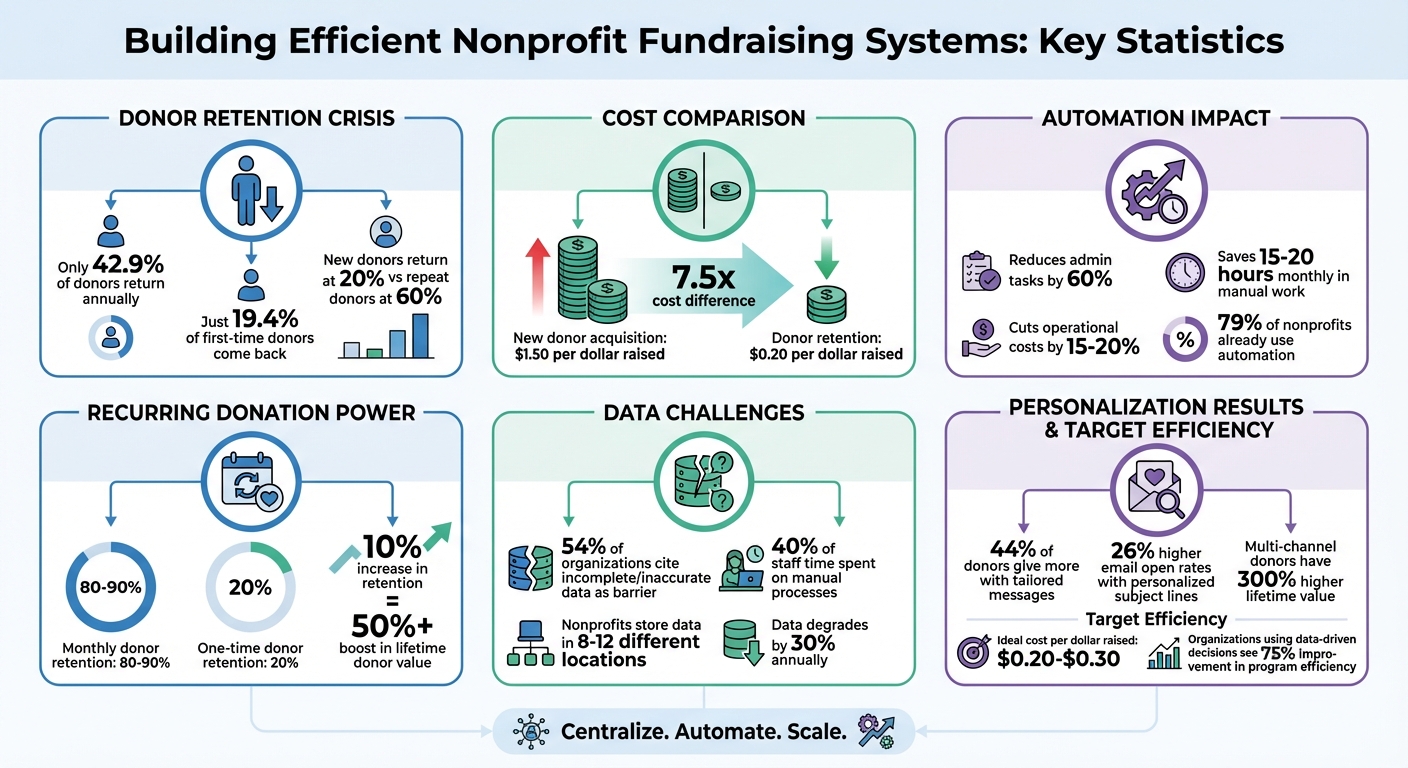
Nonprofit Fundraising Efficiency: Key Statistics on Donor Retention and Automation ROI
Nonprofit Automation That Still Feels Personal (with Rachel Bearbower)
Evaluating Your Current Fundraising Setup
The first step to improving your fundraising system is identifying what's not working. Many nonprofits still rely on outdated methods like spreadsheets, disconnected digital donor databases, and manual processes. These inefficiencies can quietly drain resources. For instance, if a development coordinator spends 8 hours a week manually entering data, that adds up to over $10,000 annually in hidden administrative costs. Imagine what that money could do if redirected toward advancing your mission.
Start with a data audit. List every place where donor information is stored - CRMs, email tools, accounting software, even personal records. It’s not uncommon for nonprofits to discover 8–12 different locations housing the same donor data. This scattered approach can lead to duplicate records, missed outreach opportunities, and reporting headaches. In fact, 54% of organizations point to incomplete or inaccurate data as a major barrier to effective fundraising.
"It's not just about understanding how much was raised, but also about understanding donor behavior and fundraising efficiency."
– Ben Miller, Chair, Fundraising Effectiveness Project
Next, track the time spent on repetitive tasks. For example, child sponsorship programs often dedicate 40% of staff time to manual processes like updating sponsor records or sending thank-you letters. If your team spends 15–20 hours monthly pulling data from multiple systems to create board reports, that’s a clear sign automation could save time and resources. Tools like the Fundraising Effectiveness Project’s free "Fundraising Fitness Test" Excel template can help you assess efficiency with just three data points: donor IDs, donation amounts, and gift dates.
Pay close attention to the "Dollars Up, Donors Down" trend. If revenue is increasing while your donor base shrinks, you might be overly dependent on a few large gifts rather than cultivating a sustainable base of recurring supporters. Retention rates tell the story: new donors return at just 20%, while repeat donors stick around at 60%. Losing donors faster than you gain them creates a costly cycle.
Finding Bottlenecks and Inefficiencies
Look for single points of failure in your workflows. If only one person knows how to manage your year-end appeal or sponsorship database, your organization is vulnerable. When that person is unavailable, operations can grind to a halt.
Also, watch for a workaround culture. If staff are creating personal spreadsheets or shadow systems, it’s a sign that your current tools aren’t meeting their needs. These workarounds often lead to data silos that make scaling operations difficult. While nearly 9 in 10 nonprofit leaders agree technology is key to fundraising success, only 29% of boards actively discuss technology strategy.
Calculate your "Inefficiency Tax" by multiplying the hours spent on manual tasks by each team member’s hourly wage. This provides a clear argument for investing in better systems. Ideally, fundraising operations should spend $0.20 to $0.30 to raise $1.00. If your cost-per-dollar-raised is higher, inefficient processes may be draining your resources.
Documenting Your Fundraising Workflows
Clear documentation is essential for efficient fundraising. Without it, processes rely on individual memory, which is unreliable. Start by mapping a simple workflow, like lapsed donor outreach. Define who handles each task and when. For example:
- The Development Coordinator pulls lapsed donor lists on the 1st of each month.
- The Development Director sends personal letters to donors giving over $1,000 by the 10th.
- The Executive Director follows up with calls to donors giving over $5,000 by the 20th.
"Data standardization is essential for nonprofits to effectively manage their donor data and make data-driven decisions."
– Nonprofit Leadership Alliance
Create a data entry style guide to address inconsistencies. Decide on standards for things like using "Street" versus "St." or formatting phone numbers. Even small inconsistencies can cause big problems, especially with automation tools. Today, 79% of nonprofits use automation in some capacity. Assign clear data ownership, ensuring specific team members are responsible for maintaining different data segments, like giving histories or contact details.
Shadow your team for a day to identify inefficiencies. For instance, if updating a donor record requires switching between your CRM, email platform, and accounting software, you’ve found a bottleneck. Research shows organizations that make data-driven decisions see a 75% improvement in program efficiency. However, that’s only possible when data is clean, centralized, and easy to access. By documenting these challenges, you set the stage for adopting better tools and systems, which we’ll explore next.
Using Donor Management Software Like HelpYouSponsor
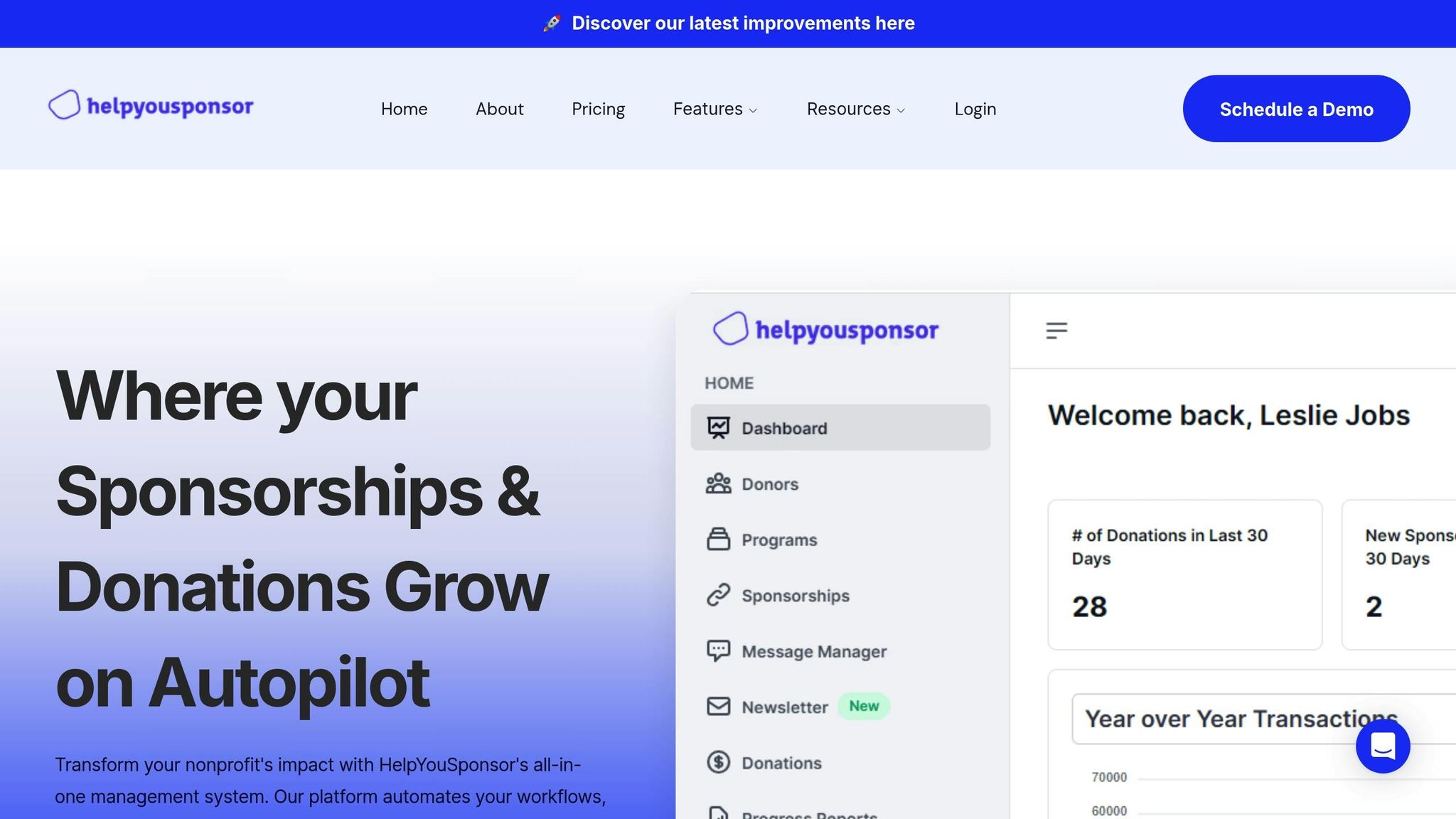
Once you’ve identified inefficiencies in your donor management process, the next step is to bring all donor data together in one place. Donor management software simplifies this by replacing scattered spreadsheets and disconnected tools with a centralized database. Take HelpYouSponsor, for instance - a platform designed specifically for nonprofits managing sponsorship programs and fundraising campaigns. It automates 90% of sponsorship-related tasks, including data entry, donation processing, and recurring payment management. The result? Smoother communication and more accurate performance tracking.
"HelpYouSponsor is an autopilot for your sponsorships and donations. We provide nonprofit organisations with a centralised platform where they can consolidate donor data, track donations, and automate the sending of receipts and thank-you messages."
– Arnold Mukisa, Founder, HelpYouSponsor
This platform has already managed over $19 million in donations and increased sponsorships by 3.8x. By automating repetitive tasks, it frees up your team to focus on what truly matters - building relationships and growing your mission.
Organizing Donor and Sponsorship Data in One Place
HelpYouSponsor consolidates all donor information into a single, secure database. Customizable online forms make it easy to capture donor contact details and preferences automatically, reducing manual data entry by 80%. When a donor signs up or makes a contribution, their information is immediately logged in the system.
The platform also integrates with popular tools like QuickBooks for accounting, Mailchimp for email marketing, and Zapier for connecting with other apps. This seamless integration keeps your data synchronized and minimizes double-entry errors.
Improving Communications and Engagement
Staying connected with donors is easier when everything is in one place. HelpYouSponsor’s integrated messaging system allows you to send updates, letters, and photos to sponsors while keeping track of all interactions. Automated email campaigns can be set up to handle key milestones, such as welcome emails, thank-you notes, and renewal reminders.
Personalized donor communication makes a big difference - 44% of donors give more when messages feel tailored to them. Emails with personalized subject lines see 26% higher open rates. You can create a welcome sequence that starts with a thank-you email right after a donation, followed by a warm welcome message within two days, and an impact story within a week or so. By segmenting donors - such as first-time versus recurring contributors - you can craft messages that resonate better with each group. This approach not only improves retention but also sets the groundwork for expanding sponsorship programs.
Organizations using these tools have seen tangible results. Farrell Burton of Hope Project International shared:
"Without this invaluable tool, our work would not be possible. With the help of HelpYouSponsor, we're making a life-changing difference for children who need it most".
While the average donor retention rate is around 45%, monthly donor retention can reach as high as 80%–90%. Even a 10% increase in retention can boost the lifetime value of your donor base by 50% or more.
Tracking and Reporting Fundraising Performance
HelpYouSponsor keeps fundraising reports and dashboards up-to-date by recording every donation and sponsorship in real time. Customizable dashboards highlight key metrics like campaign progress, new sponsorships, and donation totals at a glance. You can filter data by program, donor, region, or specific timeframes to generate detailed reports for grant applications, board meetings, or donor updates.
The platform also includes a self-service donor portal, allowing supporters to view their donation history and see the impact of their contributions. This reduces administrative workload for your team. Integration with QuickBooks ensures financial transparency and makes year-end audits less stressful.
Start by conducting a technology audit to identify bottlenecks that automated reporting could address. Use ad hoc reporting features to create specific data sets for funders or stakeholders. When nonprofits centralize their data and make it accessible, they often see a 75% improvement in program efficiency. With a streamlined system in place, automating donation processes becomes the logical next step to further optimize operations.
Automating Donation Processes and Payment Systems
When you combine a centralized donor database with automation, you can save time and improve the donor experience. Automation takes care of repetitive tasks like processing payments, sending receipts, and managing failed transactions. This shift allows your team to focus on building meaningful relationships instead of getting bogged down with administrative work. In fact, 79% of nonprofits already use automation tools for donor management, and organizations that adopt these tools report a 20–30% reduction in manual task time and a 15–20% drop in operational costs.
The magic lies in connecting your online donation forms directly to top nonprofit database solutions and payment gateways. With this setup, donor information flows seamlessly into your database, receipts are sent instantly, and transactions sync with your accounting software. This creates a streamlined, end-to-end process. Justin Wheeler, CEO and Co-founder of Funraise, sums it up well:
"As social interactions have gone digital, donations have moved into the digital realm as well, making it imperative that nonprofits evolve their ability to accept those digital donations."
This approach also lays the groundwork for recurring donations and secure payment processing.
Setting Up Recurring Donations
Recurring donations are a lifeline for nonprofits, providing steady revenue that helps with long-term planning. Donors can opt in via your website, choose their preferred payment method (credit card or ACH bank transfer), and let the platform securely store their details for automatic processing at their chosen frequency - whether monthly, quarterly, or annually. To encourage participation, make monthly giving the default option on your donation page. Keep the forms simple, asking only for essential details like name, email, and payment information to prevent donor drop-off.
While failed payments are inevitable - cards expire, accounts change - automation can handle these hiccups. Smart retry mechanisms and notification emails prompt donors to update their payment details, ensuring minimal disruption. A self-service donor portal further simplifies the process, allowing donors to update their information, adjust donation amounts, or pause contributions without needing to contact your team. This reduces administrative work and helps prevent cancellations.
Donor retention is critical for sustainability. A 10% improvement in retention can increase the lifetime value of your donor base by 50% or more. Using automated, personalized outreach can boost repeat donations by over 80%.
Once recurring donations are in place, ensuring secure and seamless payment processing becomes the next priority.
Connecting Secure Payment Gateways
Handling donor financial information comes with serious responsibility. Choose payment processors with PCI Level 1 certification, the highest standard for data security, to protect sensitive information and ensure compliance. Encryption keeps data secure during transmission, while tokenization replaces actual card numbers with unique tokens, so even in the event of a breach, no usable card data is exposed. Tools like address verification, security code checks, and AI-driven fraud screening can further safeguard transactions.
Stripe is a popular choice, offering discounted rates for nonprofits with no setup or monthly fees - just a per-transaction cost. Platforms like HelpYouSponsor integrate with major payment systems, centralizing donation records for easy reporting.
Offering multiple payment options is key to meeting donor preferences. While 63% of donors prefer credit or debit cards, including ACH transfers and digital wallets like Apple Pay and Google Pay can make giving more accessible. Since many donors give via smartphones, ensure your donation forms are mobile-friendly. Adding a checkbox for donors to "cover the processing fee" (usually around 3%) ensures their full intended gift goes to your cause - and many donors are happy to opt in.
Using hosted donation forms, where the payment processor handles the checkout page, keeps sensitive card data off your servers and reduces security risks. Automatically send branded tax receipts and thank-you emails after every successful transaction. Also, display security badges and use HTTPS on your donation pages. Branded pages are shown to receive 700% more donations than generic ones because they inspire greater trust.
sbb-itb-3ec96a5
Building Child Sponsorship Programs for Recurring Revenue
Child sponsorship programs offer a dependable monthly income stream while giving donors a direct connection to meaningful outcomes. These programs build lasting relationships with donors and deliver measurable results. For instance, sponsored children are 27–40% more likely to graduate high school and 14–17% more likely to secure salaried jobs. Such outcomes not only validate the program's effectiveness but also highlight the potential for scaling a well-structured fundraising system. By automating key processes, organizations can create deeper, long-term engagement with their donor base.
The challenge lies in designing a program that aligns with your mission and capacity. Most major sponsorship organizations suggest a monthly donation of around $39. You might choose an individual-focused model, where donations directly support a child's education, healthcare, or other needs. Alternatively, a community-focused approach pools resources for larger projects like building schools or wells, benefiting entire communities. For example, World Vision uses a community-based model with 15-year partnerships, transitioning 84 communities to self-sufficiency in 2023. On the other hand, Children International takes an individual approach, achieving a 92% global course completion rate in their Academic Reinforcement Program in 2022.
To ensure safety and sustainability, implement strict child protection measures, such as background checks for adults and supervised communication channels. Design the program with a clear exit strategy, aiming for community self-reliance. Collaborating with local leaders and NGOs is essential for respecting local contexts and ensuring the work continues effectively after your involvement ends.
Creating a Sponsorship Model That Matches Your Mission
A successful sponsorship model should focus on measurable outcomes that align with your mission and resonate with donors. Examples of impact include higher school completion rates, improved healthcare access, or increased availability of clean water. For instance, Children International's Emotional Well-Being Program engaged 62,376 participants in 2022, a notable increase of over 10,000 children compared to the previous year. Providing these tangible metrics helps donors see their contributions' value and keeps them committed.
Regular communication is crucial. Share updates quarterly or bi-annually, including photos, videos, or even children's artwork, to maintain donor engagement. For example, Feed the Children collaborated with MasterChef Junior to boost awareness, resulting in a 232% rise in social media engagement and a 96% increase in impressions. Social media's influence is significant - 55% of users who engage with nonprofits on these platforms take action, and 59% of those make donations.
Innovative ideas can also redefine traditional sponsorship dynamics. World Vision's "Chosen" program, launched in 2019, flips the process by allowing children to pick their sponsors. As World Vision puts it:
"The goal of child sponsorship is to help break the cycle of poverty so children and families can step into the future with well-founded hope."
Using Technology to Manage Sponsorships
As your sponsorship program grows, managing it manually can become overwhelming. Technology can automate up to 90% of sponsorship-related tasks, leading to a 20–25% increase in fundraising revenue [17]. This allows your team to focus more on building relationships rather than handling administrative work.
Platforms like HelpYouSponsor simplify operations by connecting donors, children, and payment schedules to avoid mismatches and data silos. This platform has processed over 19 million donations and helped organizations achieve a 3.8x increase in sponsorships.
Before choosing the best child sponsorship software, review your current workflow thoroughly. Map out each step of your sponsorship process to identify where automation could make the most impact. Ensure that any new software integrates seamlessly with your existing CRM, website, and payment systems to prevent manual data transfers. Start with core features and scale up gradually to minimize disruptions. Using specialized tools can also improve response times to donor inquiries by 60%, and 72% of nonprofit leaders believe personalized donor insights are essential for effective engagement [17].
Improving Donor Engagement and Retention
Once your systems are running smoothly, the next step is boosting donor engagement and loyalty. On average, nonprofits retain about 40% of their donors annually, but the numbers tell a different story for first-time donors - only about 20% stick around after their initial gift. However, donors who give a second time are much more likely to stay, with retention rates jumping to 60%. The secret? Making every donor feel valued and connected to your mission from the very beginning. This ties directly into the structured fundraising processes discussed earlier.
Retention is not just about sending more emails - it’s about creating meaningful relationships. As Matt Bitzegaio, CEO of HelpYouSponsor, aptly puts it:
"You're building a donor base not a database".
When donors see the impact of their support and feel part of something larger, they’re far more likely to stay engaged and contribute again.
Personalizing Donor Communication
Gone are the days when generic emails were enough. Today, donors expect personalized communication, much like what they experience from their favorite brands. And it works - customized subject lines alone can boost email open rates by 26%, and 44% of donors are more likely to give when messages align with their interests.
To start, segment your donor list beyond just donation amounts. Group supporters based on factors like recency, frequency, monetary value, timing (RFMT), interests, and behaviors. Then, use these insights to tailor your messages. For example, a donor who supported your education program might appreciate updates about student achievements rather than general news.
Some organizations are already seeing success with this approach. In 2022, the American Cancer Society used machine learning to optimize digital ad campaigns, resulting in a 17% increase in donation revenue and an 87.5% higher click-through rate compared to previous benchmarks. Boys Town achieved similar success by nurturing its text subscriber list with personalized messages, doubling its GivingTuesday text revenue in 2024.
Automation can also help. Set up behavioral triggers to send timely messages based on donor actions. For instance, if someone visits your volunteer page, follow up with information about upcoming opportunities. If a donor abandons a donation form, send a reminder within 24 hours. Multi-channel engagement is key, as donors who interact across multiple platforms have a lifetime value 300% higher than single-channel donors.
To keep communication consistent and thoughtful, create a stewardship matrix outlining how often and in what ways you’ll connect with different donor segments. Celebrate milestones like birthdays, giving anniversaries, or the one-year mark of a recurring gift. Since donor data can degrade by about 30% each year, regular data audits are essential to keep personalization effective. Once you’ve nailed personalized communication, the next step is showing donors how much they matter through strategic gratitude and recognition.
Acknowledging and Rewarding Donor Contributions
Timely, personalized recognition is a powerful way to build donor loyalty. One of the main reasons donors stop giving is that they don’t feel their contributions have made a difference. That’s why it’s crucial to show them the tangible impact of their support - not just through a generic thank-you note.
A two-step approach works well here: first, send an automated confirmation immediately after a gift. Then, follow up within 24 to 48 hours with a personal touch, like a handwritten note or a phone call. For major donors, consider having board members or leadership make the call, while mid-level donors might appreciate a note from a volunteer.
Recognition tiers can also help you tailor your approach based on donation levels. For example:
- One-time donors ($1–$250): Personalized thank-you emails and social media shoutouts.
- Recurring donors: Exclusive newsletters and program updates.
- Major donors ($1,000+): Personal calls from leadership, invitations to special events, or acknowledgment in your annual report.
Boys & Girls Clubs of America saw a 21% revenue increase in its monthly giving program by using automated gift receipts and promoting across multiple channels. Similarly, Save the Children in the Netherlands reduced its direct debit failure rate by 60% through improved technology and proactive problem-solving.
Use storytelling, photos, and testimonials to show donors the difference they’re making. Tools like ThankView can help you create video messages that foster emotional connections. Always respect donor preferences by offering them the choice to opt in or out of public recognition.
Jeff Schreifels, Principal Owner at Veritus Group, reminds us:
"You cannot automate your way to trust and you can't scale connection through software alone. You build it one donor at a time - through listening, thanking, inviting and showing up".
While automation can handle routine tasks like receipts and welcome messages, personal touches are essential for major gifts and milestones. This thoughtful combination of appreciation and tailored communication creates a strong foundation for long-term donor relationships.
Scaling Fundraising Systems with Flexible Pricing and Reporting Tools
Once your fundraising operations are automated and donor engagement is running smoothly, the next challenge is scaling your system. To grow sustainably, you need tools that can expand alongside your organization while staying affordable. Flexible pricing and thorough reporting tools are essential for managing growth effectively. These features not only keep costs manageable but also streamline processes as your donor base grows.
Adjusting to Organizational Growth
Many nonprofits face challenges with traditional pricing models that push them into higher-cost tiers before they’re ready. HelpYouSponsor addresses this with a usage-based pricing system that grows with your needs. Here’s how it works: you can start free for up to 10 donation commitments per month. After that, it’s $50/month for up to 63 commitments, and for larger programs, the cost is $0.80 per commitment.
This approach ensures you only pay for what you use - costs are tied directly to donor activity. For instance, a smaller nonprofit managing 15 sponsorships would pay $50 per month, while a larger organization handling 500 commitments would spend $400. As your team grows, you can also use custom permission settings to control data access based on roles. This ensures sensitive information is secure while allowing team members to access the data they need.
Using Detailed Reporting to Guide Decisions
With pricing that adapts to your growth, the next step is leveraging detailed reporting to make smarter decisions. HelpYouSponsor’s analytics tools provide clear, visual insights into your fundraising data. For example, you can view graphical summaries of transactions and sponsorships over the past three years. The platform also includes an activity log that tracks all payment-related events, such as successful transactions, failed payments, and donor updates. You can filter this log by categories like "Commitments" to quickly focus on specific data.
Custom reporting takes this a step further, allowing you to analyze data by recipient, program, donor, region, or time period. This level of granularity is crucial - 72% of nonprofit leaders say personalized donor insights significantly improve engagement [17].
Additionally, the self-service donor portal reduces administrative tasks by letting donors handle things like downloading tax receipts or updating payment details themselves. Integration with QuickBooks further simplifies financial management by syncing data automatically, saving organizations 15–20 hours of manual work each month. With these tools, you can pinpoint which programs are thriving, identify your most engaged donor segments, and track revenue trends. This clarity lets you allocate resources wisely, avoiding guesswork and maximizing impact.
Conclusion
Efficiency isn’t about working harder; it’s about working smarter. Nonprofits that succeed are those that leverage technology to cut out manual inefficiencies, automate repetitive tasks, and focus on what truly matters: fostering genuine connections with donors. adopting centralized donor management and recurring giving strategies can reduce operational costs by 15–20%, while also strengthening long-term donor relationships.
Recurring giving, in particular, offers a steady path to growth. Monthly donors bring in predictable revenue streams with retention rates as high as 80–90%, compared to just 20% for one-time donors. Tools like HelpYouSponsor make managing these processes seamless, allowing organizations to handle complexity without expanding their teams. This means more resources can go directly toward advancing your mission.
The numbers speak for themselves: nonprofits that fully embrace digital systems are four times more likely to achieve their mission goals. This isn’t about having a larger budget - it’s about using integrated, automated, and data-driven tools to scale effectively. Whether you’re overseeing 10 sponsorships or 500, the right technology grows alongside you, empowering your organization to make a bigger impact.
FAQs
How can nonprofits use automation to build stronger relationships with donors?
Automation offers nonprofits a way to streamline communication and reduce time spent on repetitive tasks, creating more opportunities for genuine donor engagement. For instance, automated email campaigns can keep donors informed and connected beyond their initial contribution. Regular updates and messages foster a sense of involvement, encouraging donors to give again.
Using personalized automated messages - like thank-you notes or updates on how their donations are making a difference - saves time while making donors feel appreciated. This personal touch can go a long way in building loyalty. On top of that, automating administrative tasks such as updating donor records or processing donations helps ensure accuracy and efficiency. This means staff can focus more on relationship-building efforts instead of getting bogged down in manual work.
By incorporating automation, nonprofits can deliver a more consistent and engaging experience for donors, which can ultimately lead to stronger retention rates.
What are the main advantages of centralizing donor management for nonprofits?
Centralizing donor management offers nonprofits some solid advantages. By bringing all donor information into a single system, organizations can improve data accuracy and avoid issues caused by scattered or duplicate records. This setup also simplifies tracking donor activity, contributions, and engagement, which makes personalized communication much more achievable.
With a unified system, workflows become much smoother. Tasks like sending donation receipts or follow-up messages can be automated, saving time and easing the administrative workload. Plus, these systems often include analytics tools that provide insights to help nonprofits create data-driven fundraising strategies, boosting donor retention and engagement.
In short, centralizing donor management helps nonprofits work more efficiently, build stronger relationships with donors, and free up staff to focus on connecting with supporters and advancing the organization’s mission instead of juggling disconnected systems.
How do recurring donations help nonprofits maintain financial stability?
Recurring donations are a game-changer for nonprofits, providing a steady and reliable income stream. This consistency helps organizations plan their budgets with greater confidence, ensuring they can cover essential operational expenses, keep programs running smoothly, and weather economic ups and downs or fluctuations in one-time contributions.
What’s more, donors who commit to recurring contributions often stay involved longer and give more over time compared to those who donate just once. This not only boosts donor retention but also strengthens the bond between supporters and the organization, creating loyalty and ongoing commitment. By setting up a recurring donation program, nonprofits can establish a stronger financial foundation, making it easier to focus on their mission and adapt to challenges as they arise.