

Using AI Analytics to Understand Donor Behavior
Gratona
AI is transforming how nonprofits manage donor relationships by turning data into actionable insights. From predicting donor behavior to personalizing outreach, these tools help organizations improve fundraising results and retain more donors. Here’s what you need to know:
- Why AI Matters: Nonprofits face challenges like donor fatigue and declining contributions. AI tools address this by analyzing data to predict giving patterns, segment donors, and personalized donor communication.
- Real-World Results: Organizations like the American Cancer Society and Animal Haven have used AI to boost donation revenue by over 100% and increase recurring donors by 264%.
- Key AI Capabilities: Predictive modeling identifies donors likely to give or lapse, while segmentation groups donors based on habits and preferences. AI also determines the best timing and channels for outreach.
- Data Requirements: Clean, organized donor data (financial history, engagement metrics, demographics, etc.) is essential for accurate AI predictions.
- Tracking Impact: Metrics like donor lifetime value, retention rates, and ask amount accuracy help nonprofits measure AI’s effectiveness.
AI isn’t just about automation; it’s about making smarter decisions to strengthen donor relationships and increase fundraising efficiency. Start by assessing your data quality and exploring AI-driven donor management platforms.
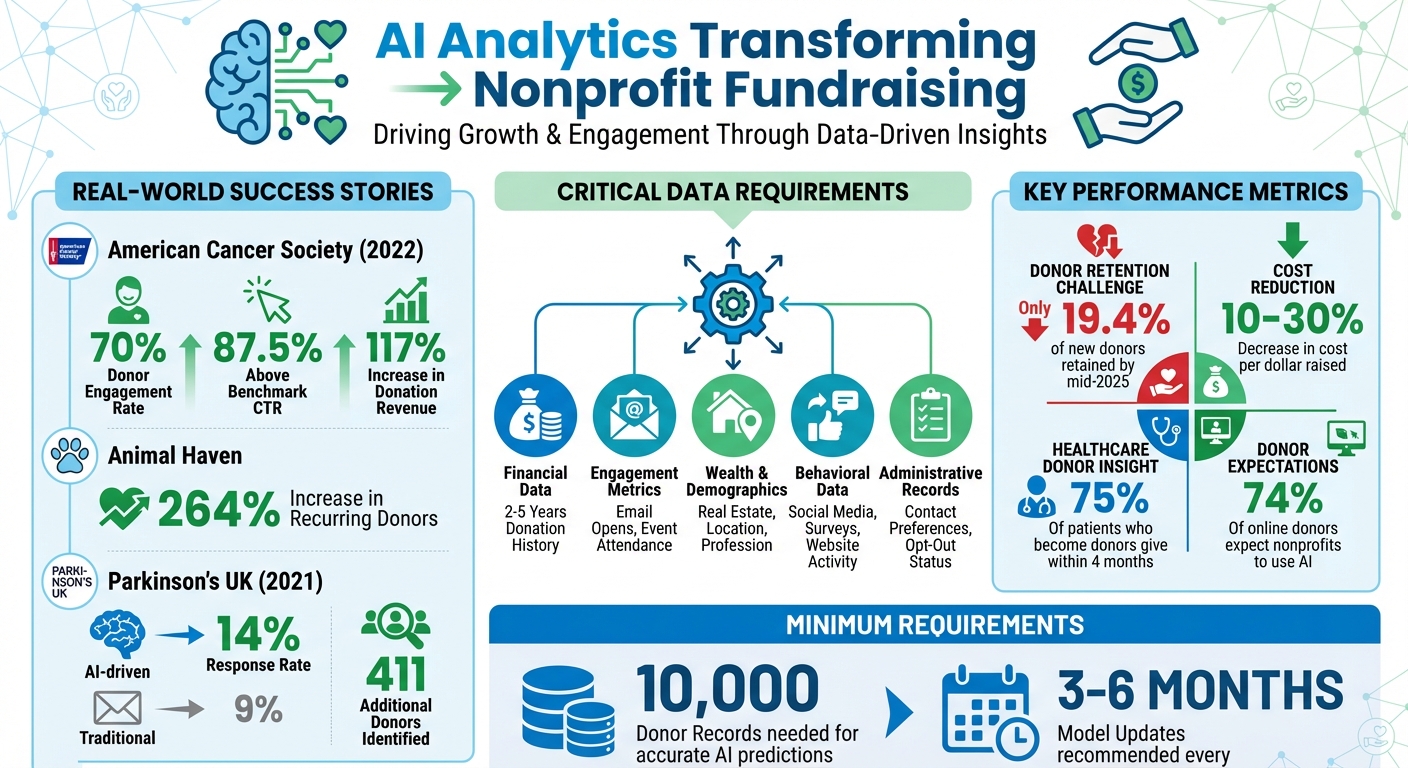
AI Analytics Impact on Nonprofit Fundraising: Key Statistics and Results
How Top Nonprofits Use Al And Donor Lifetime Value For Fundraising Success
Collecting and Analyzing Donor Data with AI
AI thrives on clean, well-rounded data from various sources. If the input data is incomplete or messy, the output will be just as flawed - it's the classic "garbage in, garbage out" scenario.
Where to Find Donor Data
Donor data typically falls into five categories: financial, engagement, wealth, behavioral, and administrative. Here's a closer look at each:
- Financial Data: At least 2–5 years of donation history is ideal, covering gift amounts, donation frequency, and recency.
- Engagement Metrics: Email open rates, click-throughs, event attendance, and volunteer hours reveal how connected donors feel to your mission.
- Wealth and Demographics: Details like real estate ownership, stock portfolios, geographic location, and professional affiliations can help identify potential major donors.
- Behavioral Data: Social media activity, survey responses, and website interactions shed light on donor interests and sentiment.
- Administrative Records: Keeping contact details, communication preferences, and opt-out statuses up-to-date ensures donors are reached through their preferred channels.
One standout statistic? Around 75% of healthcare patients who become donors make their first donation within four months of initial contact. Insights like this become clear when nonprofits track donor behavior across multiple data sources to build personalized journeys.
Bringing all these data streams together is crucial for effective AI analysis, and donor management platforms make this process much more manageable.
Using AI in Donor Management Platforms
AI-driven donor management platforms combine data from multiple sources into a single, centralized system. By integrating donation records, email engagement, and event attendance, nonprofits gain a clearer picture of donor behavior.
Take HelpYouSponsor as an example: it consolidates donation tracking, donor profiles, and communication history into one easy-to-access platform. This level of organization is essential for AI to work effectively. Machine learning models often need at least 10,000 donor records (both active and inactive) to deliver accurate predictions. HelpYouSponsor even tracks monthly donor commitments, preferred communication channels, and engagement trends automatically - no manual input required.
To keep data accurate and actionable, nonprofits should follow a few best practices:
- Standardize Data Entry: Ensure consistency in how addresses, phone numbers, and names are recorded.
- Conduct Regular Audits: Check the database every three to six months to remove duplicates and update outdated information.
- Simplify Donor Forms: Focus on capturing only the most critical information needed for effective fundraising.
Duplicate records, in particular, can skew AI predictions by inflating certain donor segments. By maintaining clean and streamlined data, nonprofits can maximize the potential of AI-powered tools to enhance their fundraising efforts.
Predicting Donor Behavior with AI
Predictive analytics taps into historical data to anticipate how donors might act. By examining past donation patterns, engagement levels, and economic factors, AI-powered models can predict individual donor behavior. This allows nonprofits to zero in on the right donors at the right time, delivering customized messages that resonate.
Take the example of Parkinson's UK in August 2021. They tested AI-driven mailing lists against their traditional approach. The AI-generated list, while smaller and more focused, achieved a 14% response rate compared to the 9% response from the conventional method. Even more impressive, the AI identified 411 donors who would have been overlooked using traditional selection techniques. This highlights how machine learning can transform donor outreach strategies.
Identifying Giving Patterns and At-Risk Donors
AI is particularly skilled at spotting trends that might otherwise slip through the cracks. By analyzing factors like Recency, Frequency, and Monetary (RFM) values alongside engagement metrics (e.g., email opens or event attendance), predictive models can estimate a donor's lifetime value and predict future contributions. This helps nonprofits recognize donors with the potential to increase their giving or even consider legacy gifts.
On the flip side, AI can flag early signs of donor disengagement. For example, a drop in email interaction or long gaps between donations might signal a waning connection. With only 19.4% of new donors retained by mid-2025, acting quickly is crucial. Strategies like sending impact reports or personalized thank-you messages can help re-engage these supporters and strengthen their commitment to your cause.
These insights also enhance the timing and personalization of fundraising efforts.
Choosing the Right Time for Fundraising Appeals
AI doesn't just identify donor behavior - it fine-tunes the timing and approach for fundraising appeals. Timing is everything. By analyzing historical giving trends, AI determines the best moments to reach out. Instead of sticking to fixed dates on a calendar, nonprofits can align their campaigns with patterns in donor behavior.
In addition, AI calculates the ideal ask amount for each donor, taking into account their past contributions and financial capacity. This ensures that donation requests feel thoughtful and personalized, increasing the likelihood of a positive response. By tailoring both the timing and the ask, nonprofits can create more meaningful connections with their supporters.
Segmenting Donors and Personalizing Outreach with AI
AI is reshaping how nonprofits connect with their supporters. Instead of sending one-size-fits-all messages, organizations can now group donors into distinct categories and craft messages that align with individual interests and giving patterns. This kind of tailored communication often boosts engagement and builds stronger relationships with donors. It also lays the groundwork for advanced strategies like RFM analysis.
Grouping Donors by Behavior and Motivation
AI dives deep into donor data - like donation history, engagement metrics, demographics, and feedback - to create meaningful segments. It evaluates key factors such as how recently someone donated, how often they contribute, and the size of their donations. Beyond that, it looks at engagement levels, like email open rates, event participation, and volunteer hours, as well as demographic details like age, location, and income brackets. Using natural language processing, AI can even analyze donor feedback to identify programs that resonate most.
RFM analysis - short for Recency, Frequency, and Monetary scoring - is another tool AI automates. It ranks donors based on their most recent gift, how often they give, and their total contributions. AI can also spot "look-alike" donors, identifying new prospects who share traits with the organization’s most loyal supporters. This makes it easier to focus acquisition efforts on individuals who are likely to become long-term contributors.
Take the American Cancer Society, for example. In 2022, they used machine learning to fine-tune their digital advertising campaigns. Under the guidance of Ben Devore, Director of Media Strategy, the project identified campaigns most likely to attract donors. The results were impressive: a donor engagement rate nearing 70%, a click-through rate 87.5% above the benchmark, and donation revenue that exceeded expectations by 117%.
Creating Personalized Fundraising Messages
Once donor segments are identified, AI steps in to help craft messages that truly resonate. By analyzing a donor's giving history and financial capacity, AI determines the ideal donation amount to request, ensuring each ask feels appropriate. It also predicts the best communication channels for each donor - whether that’s email, direct mail, phone calls, or text messages.
"Used judiciously, AI can enrich relationships by providing an even greater degree of personalization and of the targeted insights that supporters... seek to stretch every dollar to its most impactful use." - Angela Aristidou, Andrew Dunckelman & Sam Fankuchen
However, while AI can handle a lot of the heavy lifting, human oversight remains essential. Staff need to review AI-generated messages to ensure they align with the organization’s voice and values. A/B testing can also be a valuable tool for experimenting with different subject lines and messaging styles, helping nonprofits refine their approach for each donor segment.
Tracking Results and Improving AI Performance
Getting AI analytics up and running is just the starting point. Nonprofits need to keep a close eye on key metrics to ensure their AI tools are actually improving donor relationships and driving better fundraising results. Without regular tracking and updates, even the most advanced AI models can lose their edge. Here’s a closer look at the metrics and strategies nonprofits can use to keep their AI tools sharp and effective.
Metrics That Highlight AI Success
Certain metrics can give nonprofits a clear picture of how well their AI is performing. For instance, Donor Lifetime Value (LTV) measures the total revenue a donor is expected to generate over their lifetime. Meanwhile, Net LTV (NLTV) goes a step further by subtracting acquisition and annual fundraising costs, offering a more precise view of ROI.
Metrics like retention and renewal rates are also critical, showing the percentage of donors who continue to give year after year. AI models that identify donors at risk of dropping off can help improve these rates. Another key metric is ask amount accuracy, which tracks how closely a donor’s actual gift aligns with the AI’s suggested donation amount. This helps nonprofits avoid asking too little - or too much - which could lead to donor fatigue.
Other useful measures include engagement scoring, which evaluates donor interactions such as email open rates, click-through rates, and event attendance, and conversion rates, which track how many prospects complete a donation after engaging with AI-personalized content. To top it off, nonprofits should monitor cost per dollar raised, as AI can cut this by 10% to 30% by fine-tuning communication timing and frequency to match donor responsiveness.
Keeping AI Models Up to Date
AI models need regular updates and testing to stay aligned with changing donor behaviors. Experts suggest reviewing and updating predictive models every three to six months. A good rule of thumb for refreshing a model is when the number of independent variables in donor records grows by 20% or more.
Testing is another essential step. Running AI models on a small batch of new data ensures that predictions stay on track before rolling updates out to the full donor base. Nonprofits should also update models in response to major external shifts, like economic downturns or a sudden surge in new donors, which can significantly impact donor behavior.
"Our customers are saving countless hours and uncovering billions in new fundraising potential with our Intelligence for Good AI commitment - but we're just getting started." - Carrie Cobb, Chief Data and AI Officer, Blackbaud
Finally, regular data audits - such as removing duplicate records and ensuring consistent data entry - can further enhance AI performance. By staying on top of these updates and checks, nonprofits can make sure their AI tools continue to deliver accurate insights and maximize fundraising results.
Conclusion
AI analytics has emerged as a practical resource for nonprofits, offering valuable insights into donor behavior and improving fundraising outcomes. By leveraging predictive modeling, organizations can identify donors who are likely to give, upgrade their contributions, or lapse in engagement. Success begins with clean data, well-defined goals, and AI tools that integrate seamlessly with existing systems. These strategies have already delivered measurable results.
Case studies highlight how nonprofits have seen noticeable improvements in donor engagement and revenue by combining AI-driven insights with a strong focus on maintaining donor relationships.
"AI fundraising tools have revolutionized the data collection and analysis process for nonprofits. Instead of just assessing data from past campaigns, nonprofits can use machine learning tools to anticipate future donor behaviors." - CBO.io
To successfully implement AI analytics, start with a clear needs assessment. Determine your primary objectives - whether it's identifying major donors, boosting retention rates, or enhancing child sponsorship programs. Platforms like HelpYouSponsor offer comprehensive solutions, integrating unified donor profiles, payment processing, and analytics into one streamlined system.
The most critical step? Simply getting started. With 74% of online donors expecting nonprofits to use AI for marketing and fundraising tasks, the demand is already evident. By thoughtfully applying AI analytics and consistently tracking results, your organization can strengthen donor relationships, make more informed decisions, and maximize its impact on the communities it serves.
FAQs
How can nonprofits prepare their donor data for effective AI analysis?
To get accurate insights from AI tools, nonprofits need to ensure their donor data is clean, consistent, and up-to-date. When data is well-organized, AI models can make better predictions, refine donor segmentation, and improve personalization. The result? More effective fundraising efforts and stronger connections with donors.
Start by conducting a data audit to spot incomplete or outdated records, such as missing email addresses or incorrect contact information. Standardizing addresses using USPS formats and leveraging tools like the National Change of Address (NCOA) service can help keep your records current. Merge duplicate entries - those with the same name or email - and assign a unique identifier to each donor for clarity. It’s also important to suppress records for deceased individuals or contacts who are no longer eligible for outreach to avoid unnecessary communication.
Regular database maintenance, ideally on a quarterly basis, ensures your data is always AI-ready. This preparation allows nonprofits to craft precise donor profiles, develop targeted engagement strategies, and boost donation amounts, often tracked in U.S. dollars (e.g., $5,000) and recorded in the month-day-year format (e.g., January 15, 2026).
What AI tools can nonprofits use to personalize donor outreach and boost engagement?
AI tools are transforming how nonprofits connect with their donors by making outreach more personal and effective. Take predictive analytics, for instance - these platforms can dig into donor behavior, like past donations or event attendance, to pinpoint the ideal timing and messaging for outreach.
Some AI-powered tools go a step further with automated donor segmentation. They can group supporters based on shared traits, such as how often they donate or their specific interests. This allows nonprofits to create targeted campaigns - whether through email, SMS, or social media - that truly speak to each group.
With these tools, nonprofits can ensure their messages hit the mark, strengthening donor engagement and building lasting relationships.
How often should AI models be updated to accurately predict donor behavior?
Regular updates are key to keeping AI models effective in predicting donor behavior. How often you should update depends on factors like how much new data you’re collecting, shifts in donor trends, and your nonprofit’s specific objectives. For many organizations, a review and update every 6 to 12 months works well, though quicker updates might be needed if donor behavior changes suddenly.
To maintain accuracy, keep an eye on your model’s performance over time and make adjustments when necessary. Bringing in the latest data and insights ensures your nonprofit stays in tune with donor preferences and boosts engagement.