

By 2026, the world is going to be very different. But you won’t see it.
Gratona
By mid-2026, nonprofits using advanced AI tools will operate up to 10 times more efficiently, while others relying on outdated methods risk falling behind. AI is already reshaping how organizations fundraise, engage donors, and manage operations. For example:
- 82% of nonprofits currently use AI for tasks like donor segmentation, content creation, and campaign optimization using ChatGPT.
- AI-driven personalization has resulted in significant gains, like an 866% increase in converting one-time donors into recurring supporters for some organizations.
- Predictive AI is helping nonprofits anticipate donor behavior and automate re-engagement efforts, boosting retention rates.
The gap between AI-powered organizations and those that don’t adopt these tools is widening. To prepare for 2026, nonprofits should focus on these steps:
- Assess needs: Identify goals like improving retention or saving time on admin tasks.
- Build ethical policies: Ensure AI use aligns with privacy and transparency standards.
- Start small: Test AI tools in limited pilots, such as donor management systems.
- Invest in training: Equip staff to effectively use and oversee AI tools.
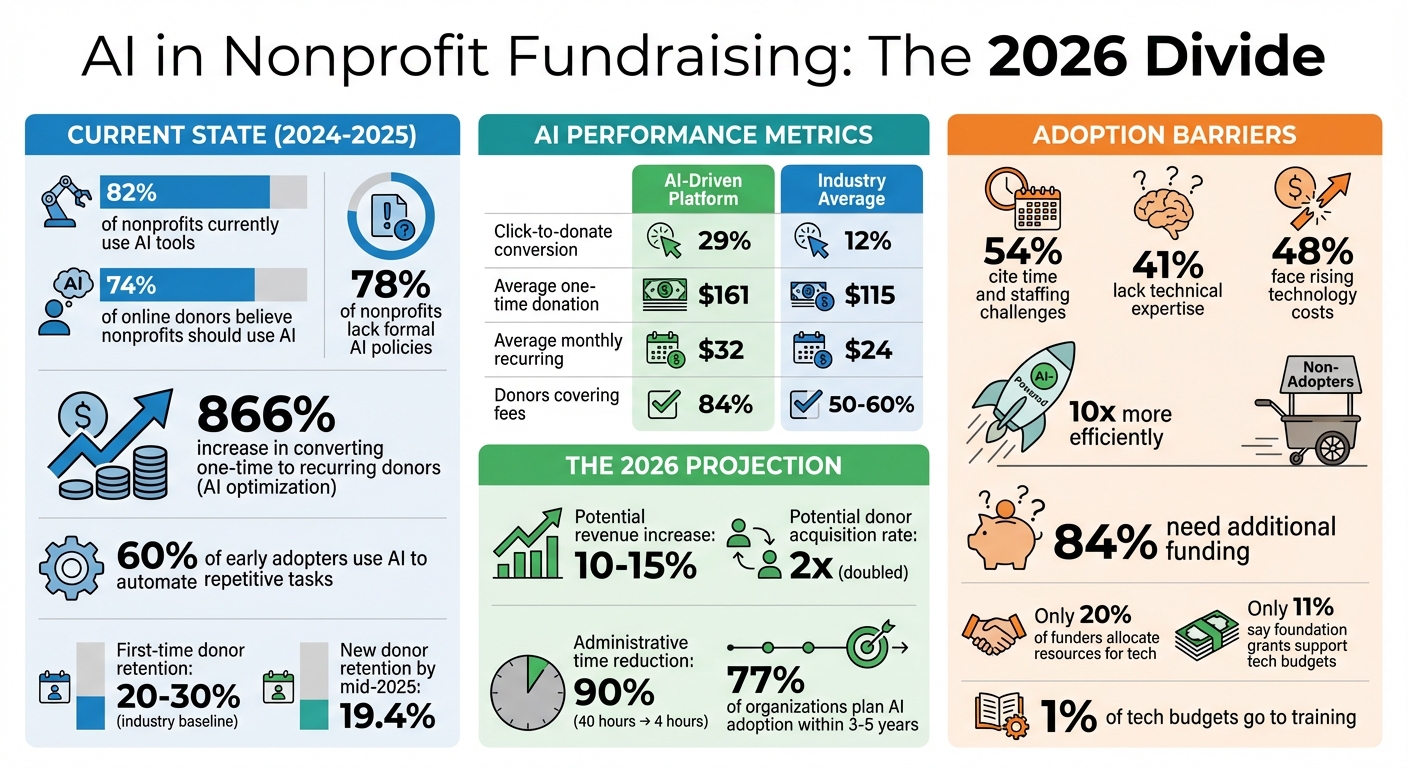
AI Adoption Impact on Nonprofit Fundraising: Key Statistics and Performance Metrics 2024-2026
The organizations that win in 2026 started building AI systems in 2025
How AI Works in Nonprofit Fundraising Today
Right now, 82% of nonprofit organizations are using AI tools. These tools have become essential for tasks like creating content, identifying potential donors, and running A/B tests. These efforts are often part of a broader donor acquisition strategy to expand the organization's reach. Nonprofits primarily rely on two types of AI: predictive AI, which analyzes donor data to predict future behavior, and generative AI, which produces new content such as email drafts, social media posts, grant proposals, and thank-you messages. Together, these technologies are helping nonprofits shift from focusing on one-time transactions to building long-term relationships with donors.
"We're at a pivotal moment where intentional technology use can create transformative change across the sector."
- Carrie Cobb, Chief Data and AI Officer, Blackbaud
Interestingly, 74% of online donors think nonprofits should use AI to help with marketing, fundraising, and administrative tasks. Donors are open to it - the real challenge is whether nonprofits have the resources to take advantage of these tools. Let’s dive into how AI is already being used for donor segmentation and campaign optimization.
AI Tools for Donor Segmentation and Campaign Optimization
In the past, donor segmentation was pretty basic. Supporters were grouped into broad categories like major donors, monthly givers, or lapsed donors. AI has completely changed the game by creating dynamic segments based on real behavior - like how donors interact with campaigns, their communication preferences, and their giving habits over time.
Here’s a great example: The Cure Alzheimer's Fund used Gravyty’s AI software to analyze donor behavior and send personalized emails based on previous actions. The tool even flagged donors who were at risk of lapsing, allowing staff to step in and re-engage them. The result? The organization raised $1.2 million.
AI also helps nonprofits figure out the next best steps for their campaigns. It can recommend the perfect donation amount, the best communication channel (email, direct mail, etc.), and even the ideal tone for messages tailored to each donor segment. This means nonprofits can move beyond generic appeals and craft messages that truly resonate with individual donors.
And this isn’t just theory. First-time donor retention rates are typically low - around 20% to 30%. AI tackles this issue by personalizing automated donor messages for re-engagement, triggered by early signs of disengagement. These tools not only improve current fundraising strategies but also prepare organizations for even more advanced AI capabilities expected to roll out by 2026.
Automating Donor Communications
AI doesn’t just help with segmentation - it also takes care of routine communications, freeing up staff to focus on building stronger donor relationships. Many tasks, like drafting thank-you notes, sending receipts, or following up with lapsed donors, are time-consuming but essential. AI automates these processes while still keeping a personal touch.
For instance, one nonprofit used AI to optimize the timing of its communications and saw an 866% increase in converting one-time donors into monthly supporters.
Another example: The American Red Cross introduced an AI chatbot called "Clara" on its website. Clara handles questions about blood donation eligibility and helps schedule appointments, offering 24/7 support while allowing staff to focus on more complex donor interactions.
"By speeding up or eliminating busywork, AI creates more space for your team to let their personalities shine through their outreach."
- LinkedIn for Nonprofits Team
The key to success here is human oversight. While AI can draft messages, it’s up to humans to refine them and ensure they feel genuine. One nonprofit, for example, managed to cut down its grant-related administrative work from 40 hours to just 4 hours, thanks to AI handling the heavy lifting while staff focused on strategic reviews.
Currently, 60% of early AI adopters in the nonprofit sector are using it to automate repetitive tasks. However, adopting AI effectively requires a mix of curiosity, time, access, and skills - elements that many organizations are still working to combine. Strategic adoption is crucial to overcoming these challenges and making the most of what AI has to offer.
What Changes by Summer 2026: The AI Divide
By summer 2026, nonprofits utilizing advanced AI will find themselves in a completely transformed environment, where cutting-edge AI reshapes fundraising and widens operational disparities. While today’s AI helps with donor segmentation and automates repetitive tasks, tomorrow’s AI will go much further - predicting donor behavior, matching sponsorship opportunities instantly, and creating highly personalized impact reports with impressive accuracy.
This divide won’t just be about having access to AI tools. It will depend on whether organizations have the curiosity, time, and expertise to use these tools effectively. Many nonprofits might possess one or two of these attributes, but very few will have all three. By 2026, the difference in productivity will be stark: AI-powered organizations will function up to ten times more efficiently, while others remain mired in manual processes.
"AI should help slow the wheel, not spin it faster. Used wisely, it can give nonprofits the time and space to restore what's been lost in fundraising over decades of transactions: trust, community, and authentic connection."
- Allison Fine, President, Every.org
The goal isn’t to replace human connection - it’s to create more opportunities for it. Nonprofits that adopt advanced AI by 2026 will spend less time on administrative tasks and more time cultivating meaningful relationships with donors. AI will handle data-heavy tasks like coordination and analysis, leaving humans free to focus on strategy and engagement. Let’s explore three major advancements that will shape this AI-driven transformation. Each builds on today’s capabilities to deliver deeper insights and stronger donor connections.
AI-Driven Donor Behavior Prediction
Today’s AI tools help with donor segmentation, but by 2026, they’ll take a giant leap forward, predicting donor needs before they even arise. Fundraising will evolve from broad, rule-based segmentation to what’s being called "precision philanthropy", where every donor is treated as a unique individual based on real-time behavioral data. Future AI won’t just analyze past giving patterns - it will proactively identify donors at risk of disengaging and automatically trigger personalized re-engagement campaigns.
These systems will process dozens of data points - such as device type, location, time of day, and browsing habits - to recommend the perfect donation amount in real time. This eliminates the guesswork of asking for too much or too little. Organizations already using predictive AI have reported a 29% click-to-donate conversion rate, compared to the 12% industry average. One nonprofit found that 73% of all gifts came from AI-driven personalized ask amounts.
The real magic happens when predictive AI (determining who to ask and when) is combined with generative AI (crafting the right message). By 2026, unified AI systems will manage the entire donor journey, potentially increasing revenue by 10–15% and doubling donor acquisition rates. This innovation will be crucial as donor retention rates have fallen to just 19.4% for new donors by mid-2025.
"In 2026, the most popular AI fundraising tool won't be the flashiest. It will be the one that predicts wisely, generates responsibly, and above all helps humans connect with humans."
- Nathan Chappell, Chief AI Officer, Virtuous Software
Real-Time Sponsorship Matching
Once donor insights are sharpened, the next step is using AI to match sponsors with the perfect opportunities. Natural language processing will soon enable instant, context-aware matching between donors and sponsorship programs. Instead of relying on manual sorting or basic keyword searches, AI will analyze complex program details and donor profiles to create meaningful matches. This is where precision philanthropy truly comes to life - connecting donors to the right opportunities at the exact moment they’re ready to give.
AI will act as an intelligent matchmaker, taking over the time-consuming task of pairing donors with campaigns. This will free up staff to focus on building relationships. For example, AI-powered platforms can cut a 40-hour administrative task - like sponsorship matching and drafting - down to a quick 4-hour strategy session, reducing time spent on low-value work by 90%.
The shift from simple automation to autonomous systems is already underway. By 2026, autonomous fundraising agents will manage digital campaigns and optimize messaging in real time, meeting donors’ growing expectations for tailored experiences.
"The challenge is coordination - matching the right donor to the right campaign at the right time. That's where AI shines."
- Chase Russell, SVP of Product Strategy and Marketing, Bonterra
Automated Impact Reporting
Frontier AI will also revolutionize how nonprofits report their impact, enhancing trust and transparency. Instead of sending generic updates, AI will generate highly personalized impact reports based on a donor’s entire journey - capturing event attendance, campaign contributions, and giving history. This will shift fundraisers from spending days crafting narratives to spending minutes refining AI-generated drafts. Tasks that once took 40 hours will be condensed into a 4-hour strategy session - a 90% reduction in workload.
For example, by August 2025, an AI platform demonstrated how it could analyze mission data and funder guidelines to streamline proposal and report writing. Modern donors, accustomed to personalized digital experiences, now expect real-time evidence of their contributions. Nonprofits that fail to meet these expectations risk losing donors. By 2026, AI will handle the heavy lifting of drafting context-aware reports, while humans add personal stories and emotional connections.
The gap between organizations will be glaring: those harnessing these tools will operate far more efficiently, while others will struggle to keep up with donor demands. This isn’t just about saving time - it’s about maintaining trust and standing out in a competitive fundraising landscape.
| Metric | AI-Driven Platform (Fundraise Up) | Industry Average |
|---|---|---|
| Conversion Rate (Click-to-Donate) | 29% | 12% |
| Average One-Time Donation | $161 | $115 |
| Average Monthly Recurring Donation | $32 | $24 |
| Donors Covering Transaction Fees | 84% | 50–60% |
How to Adopt Frontier AI by 2026
By the summer of 2026, the divide between nonprofits leveraging AI and those sticking to manual processes will be glaring. To stay ahead, adopting advanced AI tools requires a mix of curiosity, time, and expertise. The good news? You can start laying the groundwork today without needing a massive budget or a team of tech experts.
Begin with a needs assessment. Pinpoint your main goals - whether it’s identifying major donors, improving retention, or saving time on marketing. This clarity will shape your decisions moving forward. Next, take a hard look at your data. Clean, organized data is critical. Poor-quality data can lead to AI "hallucinations" or biased results, which could harm your donor relationships.
Set up an AI Use Policy. By late 2024, 78% of nonprofits still didn’t have a formal policy for AI use, even though 74% of online donors believed nonprofits should be using AI. Your policy should cover data privacy, ethical considerations, and transparency about AI’s role, while also defining when to rely on AI versus human insight. Involving your board of trustees in these decisions ensures oversight and avoids concentrating AI knowledge in just a few hands.
Start small by piloting AI tools with a limited donor group. Many nonprofits achieve quick wins by using AI features already integrated into their existing CRM or donor management systems. This approach builds confidence among your staff without adding significant costs. These trial runs can help refine your strategy and show how AI can enhance both donor engagement and operational efficiency.
Train your team to use AI tools effectively and ethically. Every AI-generated communication should be reviewed to ensure it aligns with your organization’s voice and values. By 2026, nonprofits that take these steps early will be better prepared to thrive in an AI-driven landscape.
Optimize Content for AI and Human Audiences
Once you’ve gained insights from your AI pilot programs, focus on optimizing your content to resonate with both human donors and AI systems. By 2026, AI agents will routinely scan your content to match donors with opportunities, answer questions, and extract key details. If your content isn’t structured properly, it could get overlooked.
Incorporate structured data into your website. Use clear headings, FAQ sections, and consistent formatting to make it easier for AI to process your information. For example, when describing a child sponsorship program, include details like age, location, needs, and impact in a predictable format. This approach ensures that AI systems can connect the right donors to the right programs, while still maintaining an emotional appeal for human readers.
Always review AI-generated content before publishing. Raw AI outputs can include errors, awkward phrasing, or generic language that doesn’t reflect your organization’s unique voice. By late 2024, 58% of nonprofits were already using AI for marketing, but the most successful ones treated AI as a starting point, not the final product.
You should also consider authenticating your content to combat the spread of AI-generated misinformation. A well-balanced strategy uses AI’s efficiency while keeping the personal, thoughtful elements that strengthen donor relationships.
Use Predictive Analytics for Donor Retention
Predictive AI could dramatically improve donor retention rates. Currently, first-time donor retention rates hover around 20% to 30%, and acquiring a new donor often costs 50% of their initial gift. By 2026, predictive analytics will be essential for identifying donors who might stop giving and triggering timely, personalized outreach to re-engage them.
Start by applying RFM scoring - analyzing Recency, Frequency, and Monetary value in donor histories. AI can automate this process, helping you prioritize outreach to your most engaged donors. For example, if a donor has given three times in the past year but hasn’t donated in the last four months, they might be flagged as "at risk." A follow-up email with an impact report or other meaningful update could help re-establish their connection without directly asking for another donation.
Predictive models can also analyze giving patterns and external wealth data to tailor donation requests. This eliminates the guesswork of how much to ask for and when. Nonprofits using these strategies have seen significant improvements in donor retention and conversion rates. By 2026, the most effective systems will combine predictive AI with generative AI, enabling fundraisers to fine-tune personalized outreach in minutes rather than hours.
Integrate AI-Powered Communication Tools
As predictive analytics refine donor outreach, AI-powered communication tools can elevate engagement even further. Personalized communication at scale is no longer a luxury - it’s an expectation. By 2026, AI tools will handle routine donor interactions, freeing up your team to focus on building deeper relationships.
Take Bonterra Que, for instance. This AI tool, built into donor management software, analyzes donor data to draft emails and recommend next steps for fundraisers in real time. Similarly, Gravyty creates personalized emails based on donor preferences and past actions, while flagging donors who may be at risk of lapsing. These tools are designed to enhance the work of human fundraisers, not replace them.
For organizations managing both donor and volunteer engagement, tools like Goldie from Golden offer AI-powered coaching. Goldie, led by CEO Sam Fankuchen, interacts with donors and volunteers to provide personalized recommendations for future involvement. Meanwhile, the American Red Cross uses Clara, an AI chatbot, to handle initial inquiries about blood donation eligibility and appointments. This allows staff to focus on more complex, high-touch interactions.
When choosing communication tools, start with AI features already included in your current CRM for a quick and cost-effective boost. Establish ethical guidelines - always let donors know when they’re interacting with AI, and never use sensitive donor data to train public AI models. The time saved through automation should be reinvested in personal interactions, such as one-on-one meetings with major donors or sharing beneficiary stories.
"The AI tool fundraisers actually embrace won't simply be the most accurate or articulate. It will be the most trustworthy."
- Nathan Chappell, Chief AI Officer, Virtuous Software
Challenges and Solutions for AI Adoption
Bringing cutting-edge AI into nonprofit operations isn't without its hurdles. Over half of nonprofits cite time and staffing as their biggest challenges, while 41% lack the technical expertise needed to implement AI effectively. Funding is another major roadblock - only 20% of funders allocate resources specifically for tech tools, and although 90% of nonprofits are eager to expand their use of AI, just 11% say foundation grants significantly support their tech budgets. On average, nonprofits dedicate 54% of their tech budgets to hardware but a mere 1% to training, leaving staff unprepared for AI adoption. Additionally, 48% face rising technology costs, and 84% emphasize the need for additional funding to sustain AI development. By mid-2026, these gaps will likely determine which organizations thrive in an AI-driven world and which struggle to keep up. Addressing these challenges requires targeted solutions in funding, governance, and scalable platforms.
Addressing Funding and Resource Gaps
To fully embrace AI, funders must recognize technology as a fundamental operational expense, not an optional add-on.
"Technology is a mission enabler that facilitates nonprofits' ability to achieve greater impact, generate efficiencies, and deepen engagement with their constituents" - Jean Westrick, Executive Director, Technology Association of Grantmakers
One effective approach is "pay-what-it-takes" funding - offering multiyear, unrestricted grants that cover the entire AI adoption process. This includes acquisition (such as hardware, cloud storage, and software licenses), implementation (like configuration and vendor support), ongoing operations (maintenance and upgrades), and, importantly, staff training. Without proper training, even the most advanced AI tools remain underutilized.
Nonprofits should also consider AI platforms tailored to their specific needs rather than relying on generic tools like public ChatGPT. These specialized solutions provide better data security, higher accuracy, and features designed for nonprofit workflows. Starting small can be effective - many AI-powered CRM systems now include built-in capabilities that offer quick, tangible benefits. Running short pilots, typically lasting four to six weeks, can help organizations evaluate these tools before committing to broader, custom solutions.
Building Ethical AI Governance
While funding is critical, nonprofits must also establish strong ethical frameworks to guide AI use. Organizations are responsible for all AI-generated content, including any inaccuracies or biases it may produce. This is particularly vital in programs involving sensitive data, such as child sponsorship initiatives.
By late 2024, 78% of nonprofits lacked formal AI policies, even though 74% of online donors believed nonprofits should be using AI. To address this, nonprofits need clear policies on data privacy, specifying what types of sensitive donor information can be used on various platforms. Human oversight is also essential - every piece of AI-generated content, from grant proposals to donor communications, should undergo review before being shared externally.
"AI should never replace human compassion or decision-making where people's lives are at stake" - John Manganaro, Chief Product Officer, Bonterra
This principle is especially critical when AI is used to match sponsors with beneficiaries or generate reports on program impact. In these cases, technology should enhance human decision-making, not replace it.
Threat modeling is another important step to anticipate potential risks. For example, during a "Black Cat Adoption Week" campaign, Best Friends Animal Society discovered their chatbot could unintentionally use offensive language. When efforts to train the bot on what not to say failed, they chose alternative strategies. A robust governance framework should include incident-response plans, regular policy reviews, and involvement from board members to ensure accountability. Transparency is key - donors should always know when they're interacting with AI, and sensitive donor data should never be used to train public AI models.
Scaling Operations with Usage-Based Platforms
As donation volumes and sponsorship commitments increase by 2026, nonprofits will need scalable solutions to manage the additional workload. Usage-based platforms can help by charging based on actual activity - like the number of monthly commitments - rather than requiring large upfront fees. For instance, HelpYouSponsor offers a Max Plan at $0.80 per commitment, ensuring nonprofits only pay for what they use. This model is particularly useful for managing increased donations from sources like Donor-Advised Funds (DAFs).
Platforms that integrate multiple data streams - such as email, volunteer coordination, and fundraising - into a unified system can eliminate inefficiencies and improve operations. When selecting a platform, nonprofits should assess data storage practices, understand how AI models are trained, and ensure safeguards are in place to prevent bias.
Investing in technology pays off: 96% of nonprofits that allocate resources to tech report better program and service delivery, while 89% see growth in capacity and impact. However, realizing these benefits requires viewing technology as core infrastructure, not a one-time project. Securing funding that covers setup, maintenance, and training - and allows for adjustments as AI evolves - is critical.
As AI takes over repetitive tasks, nonprofits should rethink staff roles to emphasize emotional intelligence, creativity, and oversight of AI tools. The time saved through automation can be reinvested in personal connections - meeting with major donors, sharing compelling beneficiary stories, and building lasting relationships. Striking this balance between efficiency and human connection will enable nonprofits to achieve the productivity gains projected by 2026, potentially operating up to ten times more efficiently.
Conclusion: Preparing for the Parallel World of 2026
By the summer of 2026, nonprofits working with frontier AI will find themselves in a dramatically different operating environment. With 77% of organizations planning to adopt AI within the next three to five years, those taking action today will have a clear edge. The divide between tech-savvy nonprofits and those still struggling with outdated systems will play a major role in determining which organizations thrive and which may falter.
To succeed in this shifting landscape, nonprofits need to rethink their strategies. Here are three key steps to consider: First, treat technology as a fundamental necessity, not an optional expense. Nonprofits that secure long-term funding for software, system integration, and ongoing staff training have reported substantial gains. Second, develop ethical guidelines for AI use before implementation to ensure responsible practices. Third, reallocate staff time from repetitive administrative tasks to meaningful relationship-building. The efficiency brought by AI should be used to strengthen trust and foster genuine human connections.
"AI should help slow the wheel, not spin it faster. Used wisely, it can give nonprofits the time and space to restore what's been lost in fundraising over decades of transactions: trust, community, and authentic connection." - Allison Fine, President, Every.org
Start small with four-to-six–week pilot projects that utilize built-in CRM features, and appoint AI advocates within the team to test tools and share findings. Above all, ensure that every AI-generated donor message is reviewed by a person before it’s sent. The nonprofits that strike the right balance - using AI for routine tasks while dedicating staff to listening and responding to donors - will be the ones that thrive in this new era.
FAQs
How can nonprofits use AI ethically while building donor trust?
To ensure ethical AI use and maintain donor trust, nonprofits need to establish a well-defined ethical framework. Start by implementing an appropriate-use policy that outlines how donor data will be handled. This should include measures like ensuring human oversight for critical decisions and fostering transparency. For instance, inform donors when AI tools - such as chatbots or predictive models - are being utilized, explain their purpose, and provide donors with the option to opt out if they wish.
Safeguarding donor privacy is a top priority. Conduct regular audits of data practices, use only the information donors have explicitly shared, and rigorously test AI systems to identify and address any biases. These efforts demonstrate a commitment to fairness and responsible data use, helping to reassure donors that their information is secure.
Ethics should also be treated as an ongoing process. Train your team on the responsible use of AI, schedule periodic audits, and keep donors informed about how AI is contributing to your mission. By prioritizing transparency and ethical practices, nonprofits can use AI as a tool to strengthen trust and enhance their impact.
What challenges will nonprofits face when adopting AI by 2026?
Nonprofits aiming to embrace AI by 2026 will face several notable challenges. One of the biggest obstacles is budget constraints. Many organizations simply don’t have the financial resources to invest in AI tools, cloud services, or the skilled professionals needed to implement and manage these technologies effectively.
Another hurdle is the lack of in-house expertise. Without knowledgeable staff, nonprofits may find themselves relying on outsourcing, which can be costly and time-consuming, or delaying their AI adoption plans entirely.
There are also ethical concerns to navigate. Issues like donor privacy, potential bias in AI systems, and staying true to the organization’s mission require careful consideration. Developing clear policies for the responsible use of AI will be critical to addressing these concerns.
Lastly, nonprofits often struggle with operational and cultural gaps. Outdated digital infrastructure and resistance to change can make it difficult to keep up with the fast-moving world of AI. Tackling these challenges head-on will be vital for nonprofits to unlock the full benefits AI can offer by 2026.
How can nonprofits use AI to improve donor retention and engagement?
AI is reshaping the way nonprofits engage with their donors, turning what once seemed like overwhelming data into clear, actionable strategies. By digging into donation patterns, communication habits, and engagement trends, AI pinpoints donors who might be losing interest. This allows nonprofits to step in with personalized outreach - whether it's a heartfelt message or an update that resonates with their interests. It also helps create smaller, targeted groups for campaigns that feel more personal, ensuring donors stay connected to the cause.
On top of that, generative AI takes care of time-consuming tasks like drafting thank-you notes, scheduling follow-ups, and handling routine inquiries. This gives staff more time to focus on what really matters: building meaningful relationships. Sentiment analysis tools also come into play, tracking donor feedback so nonprofits can tweak their messaging on the fly, keeping trust and enthusiasm alive. By using these tools, nonprofits not only strengthen donor loyalty but also make their day-to-day operations more efficient.