
HelpYouSponsor
Back to Blog
SMART Goals for Nonprofit Events
11 min read·April 21, 2026

SMART Goals for Nonprofit Events

helpyousponsor

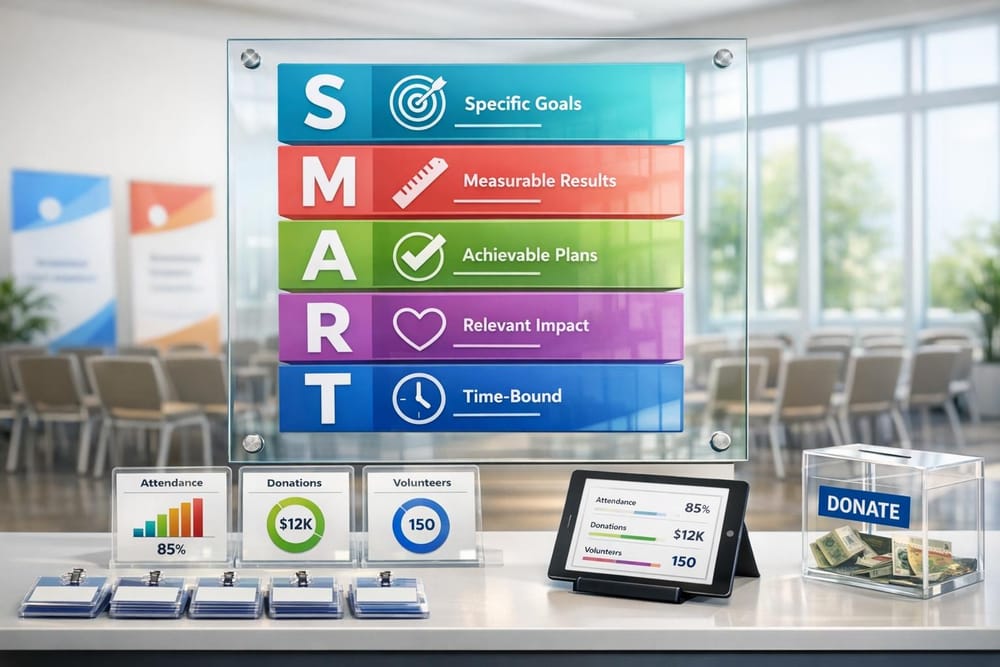
Planning a nonprofit event without clear goals is like driving without a map - you stay busy but may not reach your destination. The SMART framework helps nonprofits set clear, actionable goals to make the most of limited resources and ensure success. SMART stands for:

  • Specific: Define exactly what you want to achieve.
  • Measurable: Use metrics to track progress.
  • Achievable: Set realistic goals based on your resources.
  • Relevant: Align goals with your mission.
  • Time-Based: Set deadlines to stay on track.

For example, instead of saying, "We want a successful fundraiser", a SMART goal would be: "Raise $25,000 through our spring gala by May 30, 2026, to support 50 students in after-school programs." This clarity motivates teams, keeps everyone aligned, and demonstrates impact to donors.

Key benefits of SMART goals include:

  • Clear direction for your event.
  • Metrics to measure success and adjust strategies.
  • Accountability across your team.
  • Better alignment with your nonprofit’s mission.
SMART Goals Framework for Nonprofit Events

SMART Goals Framework for Nonprofit Events

Understanding the SMART Framework

The SMART framework takes lofty ambitions and transforms them into actionable plans. Each element focuses on a critical aspect of goal-setting, helping your team move from ideas to tangible results.

What 'Specific' Means in Event Planning

A specific goal answers three key questions: what you want to achieve, why it’s important, and how you’ll accomplish it. For instance, instead of saying, "we want a successful fundraiser", a specific goal would be: "we will raise $25,000 through our spring gala to fund after-school programs for 50 students." This level of detail ensures everyone is aligned and working toward the same objective.

When the team understands exactly what success looks like, they can make smarter decisions about allocating time and resources for your nonprofit event.

Making Goals Measurable

Measurable goals rely on Key Performance Indicators (KPIs) to track progress and hold everyone accountable. These could include metrics like total dollars raised, attendance numbers, new donor sign-ups, or social media engagement rates. The key is to choose indicators that reflect both short-term outputs (e.g., event attendance) and long-term outcomes (e.g., donor retention or community impact).

By turning goals into measurable benchmarks, you can adjust strategies in real time based on actual progress.

Setting Achievable Goals

Achievable goals require a realistic evaluation of your organization’s resources and capabilities. Before committing, ask whether your team, volunteers, budget, and schedule can realistically support the goal. It’s also important to weigh how other priorities might compete for the same resources.

This doesn’t mean avoiding challenges - it’s about being practical. For example, if your nonprofit has only hosted events for up to 50 people, planning a gala for 500 attendees could overwhelm your team. Start by asking: do we have the resources to meet this goal within our timeline?

Aligning Goals with Your Mission

Relevant goals directly tie into your nonprofit’s mission and immediate priorities. Even a worthwhile goal can be a distraction if it doesn’t align with current focus areas. For instance, launching a corporate sponsorship program might be a great idea, but if your current priority is building relationships with individual donors, it may not make sense right now.

To ensure relevance, list potential goals and rank them based on how closely they align with your mission and strategic needs. This approach helps your team channel energy into what matters most today.

Setting Time-Bound Goals

Time-bound goals establish deadlines and milestones, creating urgency and accountability. Without a clear timeframe, it’s easy for goals to drift. Deadlines act as built-in motivators - if you’re halfway through a two-month campaign and only 15% toward your target, the timeline pushes you to reassess and adapt.

"If a goal isn't time-based, you can put it off indefinitely." - Ilma Ibrisevic, Content Writer, Donorbox

For example, if your annual fundraising goal is $50,000, breaking it into quarterly benchmarks of $12,500 provides regular checkpoints to celebrate progress or pivot as needed.

Now that you understand the SMART framework, let’s explore how to apply these principles to craft strategic event plans.

How to Apply SMART Goals to Your Events

Understanding the SMART framework is just the beginning - making it work for your event planning is where things get interesting. Here's how to turn this framework into actionable strategies for your next nonprofit event.

Define Your Event's Purpose

Start by getting specific about what you want to achieve. A vague goal like "hosting a successful event" won’t cut it. Instead, pinpoint clear outcomes: Are you aiming to raise $15,000 for youth programs? Recruit 100 new monthly donors? Boost community awareness among 500 local residents? These specific objectives give your event a clear direction.

Your purpose should answer three key questions: What are you trying to achieve? Why does it matter to your mission? Who benefits from your success? For instance, a goal like "We will raise $25,000 through our fall gala to fund mental health services for 75 veterans" provides clarity and ties the event directly to your nonprofit's impact. Plus, it ensures your event aligns with your organization's annual goals.

Instead of viewing your event as either a complete success or a total failure, set a range of acceptable outcomes. For example, if last year’s event raised $20,000 with 200 attendees, you might consider this year’s event a win if it raises the same amount with fewer attendees, as long as donor engagement improves.

Identify Key Metrics

Once your purpose is clear, shift your focus to measurable numbers. Choose specific metrics to track progress. Financial metrics, like total funds raised and cost per dollar raised, can help you gauge efficiency. Engagement metrics, such as attendee numbers, volunteer hours, and donor conversion rates, reveal how well you’re connecting with your audience.

But don’t stop with just output metrics; outcomes matter too. For example, if your event aims to raise awareness about homelessness, use pre- and post-event surveys to measure changes in community knowledge, rather than relying solely on attendance numbers. For charity events, a common benchmark is achieving a satisfaction rating of 4 out of 5 from at least 80% of attendees.

Also, take a look at your organization's financial health to ensure your plans are realistic. Use tools like the current ratio (current assets divided by current liabilities) to confirm you can meet short-term obligations while pursuing your goals. For larger fundraising targets, break them into smaller, manageable milestones - like hitting $12,500 every quarter if your annual goal is $50,000.

Assign Tasks and Deadlines

With goals and metrics in place, it’s time to break things down into actionable steps. Divide your event goal into smaller tasks, assign them to team members, and set deadlines. Matching tasks to each person’s skills and availability ensures everything stays realistic and achievable.

Create a detailed timeline that includes every responsibility and deadline. For example, if your gala is set for October 15, 2026, you might aim to finalize venue contracts by June 1, start sponsor outreach by July 15, and launch ticket sales by August 1. Regular check-ins - weekly or biweekly - help keep things on track, while announcing goals organization-wide fosters shared accountability.

"Having 'check-in' points when you take a look at your progress together with your team will be invaluable when it comes to staying accountable." - Donorbox

Visual tools like fundraising thermometers can also help. They let your team and donors see progress in real time. For instance, if you’re halfway through your timeline but only at 15% of your fundraising goal, these check-ins allow you to adjust your strategy quickly, like ramping up outreach efforts.

Examples of SMART Goals for Nonprofit Events

Applying SMART goals to your nonprofit events can bring clarity and focus to your planning process. Below are two examples that show how structured goal-setting can elevate different types of nonprofit events.

Example: Fundraising Gala

Fundraising galas often involve multiple revenue streams, so your SMART goals should address each one. Instead of a vague aim like "raise money", break your objective into specific, measurable targets. For example: "We will raise $50,000 by October 15, 2026, with $10,000 from sponsorships0,000 from sponsorships, $15,000 from ticket sales, $10,000 from paddle raises, and $15,000 from auctions." This goal provides a clear financial breakdown and deadline, ensuring accountability.

Statistics back up the importance of detailed planning: In 2024, 51% of nonprofits hosting galas met their budgets, while 26% exceeded their goals. A standout example from 2025 showed a gala that emphasized survivor narratives, resulting in paddle raises surpassing the initial goal by 60%, and auction revenues exceeding targets by 160%. These results highlight how storytelling and emotional connections can significantly boost fundraising success.

"The gala is your nonprofit's chance to share the story you want your audience to remember when they think about your issue area." - Jessica Mecellem, Ph.D. and Vanessa Wakeman

Beyond fundraising, set SMART goals for donor acquisition. For instance, aim to collect 100 new donor contacts by the event's conclusion. Tools like donation kiosks, text-to-give options, and QR codes can track real-time contributions and engagement during the gala.

Example: Community Awareness Campaign

For awareness campaigns, focus your SMART goals on audience reach and engagement rather than immediate fundraising. A specific example might be: "We will reach 10,000 local residents during our May 2026 mental health awareness campaign by posting three educational videos weekly on social media and hosting two community workshops." This goal is both measurable and time-bound, making it easier to track progress.

Metrics like impressions, new followers, newsletter sign-ups, video views, and petition signatures can help gauge success. If a previous campaign achieved 20% follower growth, aim for a 30% increase in your next campaign to push your reach further. Building a larger audience now lays the groundwork for future engagement and action.

"Your mission is the heartbeat of your organization, and an awareness campaign is the perfect opportunity to highlight it." - Sarah Sebastian, Director of Corporate Communications, OneCause

Timing is critical for awareness campaigns. Align your efforts with national observances, like October's Breast Cancer Awareness Month, to leverage public interest. Regular check-ins - such as bi-weekly strategy meetings - help keep the campaign on track and allow for adjustments based on real-time data. Instead of asking for donations immediately, use calls-to-action like signing petitions, subscribing to newsletters, or watching educational videos to build long-term engagement.

Tracking and Adjusting Your Event Goals

Using Tools to Monitor Event Metrics

Once you've set your SMART goals, keeping an eye on progress in real time is key to staying on track. Modern event platforms make this easier by syncing registration and donation data directly with your CRM, giving you instant updates on engagement and fundraising efforts. Mobile apps also play a big role, enabling staff to scan tickets, check in attendees, and process donations on the spot - all while automatically updating your records.

Visual tools, like live progress displays, can be a powerful motivator. For example, showing real-time fundraising progress on a big screen can energize donors and encourage more contributions.

"Setting goals lets you track progress and gives you the info you need to tweak your strategies as you go." - Christina Tomlinson, VP of Marketing & Events at Pathable

Platforms like HelpYouSponsor focus on seven essential metrics for sponsorship programs: Acquisition Rate, Retention Rate, ROI, Engagement Level, Brand Awareness, Goal Progress, and Long-term Value. These metrics go beyond just dollars raised, offering insights into sponsor and donor engagement with your mission. HelpYouSponsor also provides tools to track these metrics, helping you stay data-driven. Interestingly, campaigns that update supporters every five days raise three times more than those that don’t.

By monitoring these metrics continuously, you set the stage for timely adjustments that can make a big difference.

Adjusting Goals Based on Real-Time Data

Real-time data allows you to refine your strategy as you go. Automated reports help identify non-donors and first-time donors, enabling targeted outreach that can boost engagement.

"Regularly observing performance and ensuring KPIs are on track enable you to identify areas requiring immediate attention and make course corrections." - FrontStream

Breaking large event goals into smaller, more manageable milestones - monthly or quarterly - makes it easier to pinpoint when a goal may need adjusting. If certain initiatives aren’t delivering the results you need, consider shifting your budget to stabilize finances. Collaboration is also key here: involve board members, staff, donors, and volunteers to brainstorm fresh fundraising ideas when original plans fall short. Being flexible and adapting based on live data ensures your event stays aligned with its goals.

Conclusion

Using SMART goals can completely change how your nonprofit approaches event planning and execution. Instead of chasing vague ideas, you’ll have specific, actionable targets that align your team’s efforts. This focus not only keeps staff and volunteers motivated but also ensures everyone is working toward outcomes that truly make a difference.

With clearly defined goals, you can also make better use of resources by tracking key metrics like dollars raised, attendee numbers, and sponsor commitments. These insights help you identify what’s working and where improvements are needed. In fact, more than 50,000 nonprofits already rely on online fundraising tools to enhance their goal-tracking processes, showing that data-driven strategies aren’t just for large organizations.

"Goals are more likely to be achieved if donors can clearly see the fundraising progress and they can easily visualize their impact." – Donorbox

Look back at past events to identify what went well, then involve your board, staff, and volunteers to set goals that align with your mission. Break down larger objectives into smaller, manageable milestones - whether monthly or quarterly - to keep the momentum going and avoid burnout. Tools like HelpYouSponsor can simplify this process by tracking metrics in real time, so you stay on track. By adopting SMART goals, your event planning becomes more focused, effective, and mission-driven.

FAQs

How do I pick the right KPIs for my event?

When selecting KPIs, it’s essential to align them with your SMART goals - those that are specific, measurable, achievable, relevant, and time-bound. Start by identifying clear outcomes you want to achieve. For example, are you aiming to boost attendance at an event or increase your fundraising totals?

Once your objectives are clear, focus on metrics that can be tracked. This might include ticket sales, donation amounts, or other quantifiable data points that directly reflect your goals. It’s also important to ensure these KPIs are realistic given your resources and timeline.

Finally, set deadlines for achieving these metrics. Clear timeframes help your team stay focused and ensure your goals remain actionable and grounded in reality.

What if our SMART goal turns out to be unrealistic?

If your SMART goal feels out of reach, it's important to pause and reevaluate. Unrealistic goals can drain your energy and dampen your motivation. By shifting your focus to a more attainable objective, you can keep making progress while staying motivated and confident in your efforts.

How can HelpYouSponsor help track SMART goals in real time?

HelpYouSponsor makes tracking SMART goals easier by providing detailed metrics and analytics in real time. Nonprofits can keep an eye on key areas such as beneficiary satisfaction, fund utilization, volunteer participation, and goal achievement rates. These insights allow organizations to evaluate their progress accurately and fine-tune their strategies when necessary.

Related Blog Posts